Overview
Infertility rarely announces itself loudly.
It doesn’t always come with pain, dramatic symptoms, or a clear moment where something “goes wrong.” Most of the time, it creeps in quietly. A cycle that feels slightly off. A year that passes faster than expected. A growing sense that effort isn’t translating into outcome.
And because these signs feel small, people wait. They normalise. They tell themselves to relax, to give it more time.
Sometimes that patience helps.
Often, it only delays clarity.
Knowing the early signs of infertility isn’t about panic. It’s about recognising when the body is asking for attention.
1. Irregular or Unpredictable Periods
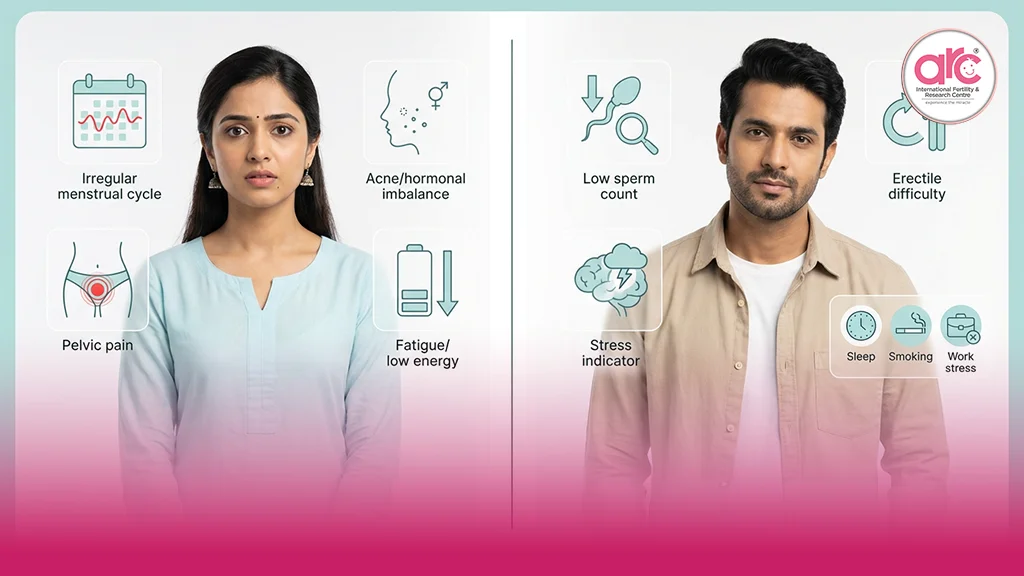
A regular cycle is not a guarantee of fertility, but an irregular one is often a signal worth listening to.
Cycles that change length frequently, skip months, arrive too early, or disappear altogether usually reflect ovulation issues. Hormonal imbalances, thyroid problems, PCOS, or excessive stress can all disrupt the delicate rhythm required for conception.
Many women are told irregular cycles are “common.” Common does not mean harmless. If ovulation is inconsistent, timing becomes guesswork, and guesswork is not a strategy for pregnancy.
2. Very Painful or Extremely Heavy Periods
Pain is often dismissed as part of womanhood. It shouldn’t be.
Periods that interfere with daily life, require frequent painkillers, or involve excessive bleeding can point to conditions like endometriosis, fibroids, or adenomyosis. These conditions don’t always prevent pregnancy outright, but they can significantly reduce implantation success and increase miscarriage risk.
When pain is chronic, it’s information. Not endurance training.
3. No Pregnancy After 12 Months (or 6 Months if Over 35)
This is the sign most people know, and still delay acting on.
If you’re under 35 and have been trying for a year without success, or over 35 and trying for six months, it’s time to investigate. Not because something is definitely wrong, but because time is biologically expensive.
At a fertility hospital in chennai, many couples arrive saying, “We thought we should wait longer.” Almost none say, “We came too early.”
4. Low Libido, Erectile Issues, or Ejaculatory Changes in Men
Male fertility issues often hide behind silence.
Low sexual desire, difficulty maintaining erections, or changes in ejaculation are sometimes brushed off as stress or age. While stress does play a role, these symptoms can also reflect hormonal imbalances, vascular issues, or testicular dysfunction that directly impact sperm production.
Men are rarely taught to associate sexual health with fertility health. But the connection is real, and ignoring it doesn’t make it disappear.
5. History of Pelvic Infections, Surgeries, or STIs
Past events matter, even if they feel resolved.
Pelvic infections can cause silent scarring. Surgeries can lead to adhesions. Untreated or late-treated STIs can alter reproductive anatomy in both women and men.
Many of these changes don’t cause daily discomfort. They simply reduce the chances of sperm meeting egg, or embryo implanting successfully.
When conception doesn’t happen despite “normal” tests, history often fills in the missing gaps.
6. Noticeable Changes in Semen or Testicular Health
Semen that looks consistently watery, discoloured, or reduced in volume can signal underlying issues. So can testicular pain, swelling, or asymmetry.
Sperm health isn’t only about numbers on a report. It’s also about quality, DNA integrity, and the environment in which sperm are produced.
Lifestyle factors matter here too. Heat exposure, prolonged sitting, and even clothing choices can influence sperm health. If you’re curious about how everyday habits play a role, how synthetic clothing affects fertility in men and women explains why seemingly small choices can have biological consequences over time.
7. Repeated Pregnancy Loss or Failed Fertility Treatments
Few experiences are as emotionally exhausting as repeated disappointment.
Recurrent miscarriages or multiple failed IUI or IVF cycles are not just bad luck. They often point to deeper issues, genetic, hormonal, uterine, or sperm-related, that require specialised evaluation.
This is where working with the best fertility hospital in chennai becomes critical. Not for more aggressive treatment, but for better diagnosis. Repeating the same approach without understanding why it failed is not persistence. It’s stagnation.
Why Early Evaluation Matters More Than People Think
Fertility doesn’t decline in a straight line. It drops in steps. Often suddenly.
What feels like “just a few months more” can quietly move someone from a window of easier intervention to one that requires more complex treatment. Early evaluation doesn’t force treatment. It creates options.
It allows couples to correct what’s correctable, monitor what needs time, and plan realistically instead of emotionally.
Seeing a Specialist Is Not Admitting Defeat
This is where many people get stuck.
They worry that seeing a specialist means accepting something is wrong. It doesn’t. It means you’re choosing information over assumption.
Fertility specialists don’t exist only for IVF. They exist to interpret patterns, identify obstacles, and help the body work better with support, not against it.
Sometimes the answer is reassurance. Sometimes it’s treatment. Both are valuable.
The Quiet Truth About Infertility
Infertility is rarely a single dramatic failure. It’s usually a series of small signals that went unnoticed for too long.
The body speaks early.
It just doesn’t shout.
Learning to listen doesn’t create fear. It creates timing. And in fertility, timing changes everything.
If you recognise yourself in more than one of these signs, don’t wait for certainty to seek clarity. The goal isn’t to rush into treatment. The goal is to stop guessing.
Because the earlier you understand what’s happening, the more gently and effectively it can be addressed.