Overview
She was 32, leading a team of twelve and had just been offered a role she had worked toward for six years.
She also knew quietly, in a way she had not yet said out loud that the question of children was not going away.
Just not yet. Not right now.
A colleague mentioned egg freezing over lunch one afternoon. Not as a dramatic decision. As a practical one.
“I just did not want biology to make the decision for me”, her colleague said.
That sentence stayed with her.
Why is it that career women freeze eggs is no longer a niche conversation happening in fertility clinics only? It is happening at office lunches, in whatsapp groups, between sisters and friends, quietly, practically and with increasing frequency across Indian cities including Chennai.
And the question it leads to is deeply personal: “Is it right for you?”
The Numbers Behind the Trend
This is not a small or passing shift.
A growing number of Indian women are turning to egg freezing as a way to take control of their reproductive futures, as delayed motherhood, increasing infertility and growing awareness around fertility preservation drive demand across the country. The Indian egg-freezing and embryo-banking market was valued at $206 million in 2023 and is projected to grow at a compound annual growth rate of 17.4% to reach $632.5 million by 2030.
The Indian Society for Assisted Reproduction states that, “The number of women undergoing elective egg freezing has increased by almost 25% annually over the last five years”
These are not numbers from a niche procedure. They reflect a shift in how a generation of Indian women is thinking about fertility, not as something that simply happens or does not, but as something that can be planned for, like a career milestone or a financial goal.
Egg freezing has become a valuable reproductive option for women who wish to delay childbearing, often due to educational or professional goals. As more women pursue higher education and career advancement, they may choose to freeze their eggs as a way to preserve fertility and mitigate age-related fertility decline.
What Egg Freezing Actually Does? Simply Explained
Egg freezing, medically called oocyte cryopreservation, preserves your eggs at the biological age they are at the time of freezing.
A 29-year-old who freezes her eggs and uses them at 38 is working with eggs that are biologically 29. That distinction is not a small one. That is the entire point.
The process involves a short course of hormone injections, typically 10 to 14 days, to stimulate the ovaries to produce multiple eggs in one cycle. Those eggs are retrieved under mild sedation, assessed in the laboratory and frozen using a rapid-cooling technique called vitrification.
They are then stored until you decide to use them, whether that is in two years, five years or ten.
For a complete breakdown of the process, who it is suitable for, what each stage involves and what to expect from retrieval through to storage, our guide on everything you need to know about egg freezing covers it thoroughly.
Why Age at Freezing Matters More Than Most Women Are Told?
This is the piece of information that changes how urgently women approach this decision.
A 2024 meta-analysis revealed that women who froze eggs prior to age 35 were 50% likely to have a live birth, but those who froze eggs after age 40 had rates decline to approximately 20%. Women under 37 need to freeze approximately 14 to 15 mature eggs to achieve around a 70% chance of at least one live birth. Women above 38 may need to freeze 25 to 26 eggs to have comparable odds.
The eggs you freeze at 30 are not the same as the eggs you would freeze at 38.
Both in quality, eggs accumulate DNA damage and chromosomal abnormalities with age and in quantity, which declines with every passing year.
This is not a reason for panic. It is a reason for timely information.
Most women who consider egg freezing at 35 wish they had looked into it at 30. Most who look into it at 30 wish they had known about it at 27.
The best time to ask the question is earlier than feels urgent.
Is It Right for You? Honest Questions Worth Asking
Why career women freeze eggs is well documented. The more personal question, whether it is the right decision for you specifically depends on several things that go beyond the statistics.
“Are you in your late 20s or early 30s with no current partner or plan to conceive in the next 2-3 years?”
This is the profile where egg freezing has the clearest value. You are young enough that egg quality is on your side. You are far enough from having children that freezing buys meaningful time without rushing a decision.
“Do you have a medical condition that may affect fertility: PCOS, endometriosis, low AMH, a family history of early menopause?”
For women with conditions that may accelerate fertility decline, freezing earlier is not just a lifestyle choice. It is a medically informed one.
“Are you about to undergo treatment: chemotherapy, radiation that may affect your fertility?”
This is the medical egg freezing scenario and the timeline is more urgent than the elective one. The window between diagnosis and treatment is narrow. Our guide on whether you can save your fertility before chemotherapy explains exactly how that works and what the realistic options look like.
“Do you understand what egg freezing does not guarantee?”
Eggs are biological material. Not every egg survives freezing and thawing. Not every egg fertilises. Not every embryo implants. Egg freezing preserves options. It does not guarantee a baby. That distinction matters when making the decision.
What the ARC Evaluation Looks Like?
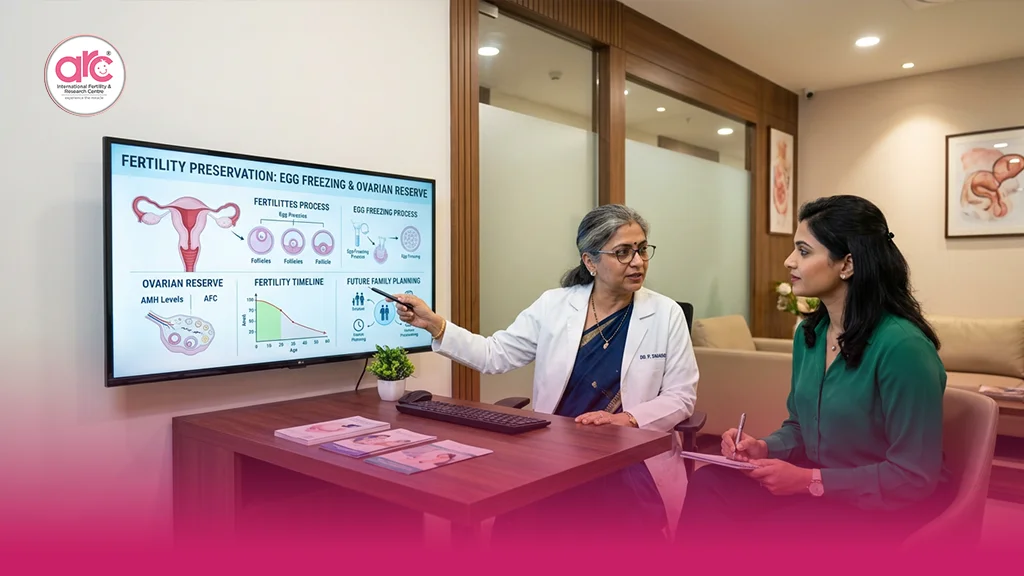
Before egg freezing begins at ARC, the evaluation is designed to give you a realistic picture of what you are working with.
This includes:
- AMH blood test: To assess your current ovarian reserve and how many eggs your ovaries are likely to produce in one stimulation cycle
- Antral follicle count: A transvaginal ultrasound scan counting the follicles visible at the start of your cycle
- Day two or three FSH and estradiol: To assess the hormonal environment heading into stimulation
- Full medical history including any conditions, medications or family history relevant to fertility
These results shape the stimulation protocol, the expected egg yield and the honest conversation about whether now is the right time or whether the window is already closing in a way you need to know about.
The Conversation Most Women Wish They Had Started Earlier
Women who freeze their eggs report a 75% higher sense of reproductive control, the ability to align family planning with personal and career aspirations without the immediate pressure of a biological deadline.
That statistic captures something that goes beyond the clinical.
Egg freezing does not remove the complexity of the decision to have children. It does not solve the challenge of finding the right relationship or the right moment. It does not guarantee a pregnancy.
What it does is remove one specific pressure, the relentless biological clock, from a decision that deserves to be made freely, without biology forcing the timeline.
For women in demanding careers, navigating ambitious professional goals alongside deeply personal life questions, that removal of pressure is not trivial.
That is the point!
At a dedicated fertility hospital in Chennai, the egg freezing consultation at ARC begins with a conversation, not a sales pitch. What your ovarian reserve looks like right now. What a realistic stimulation cycle might produce. What the success rates look like for your specific age and profile. And what the alternatives are if egg freezing is not the right fit.
Because the goal is not to freeze eggs.
The goal is to give you the information to make the right decision for your life on your timeline, with your biology fully understood.
At the best fertility hospital in Chennai, that conversation is available whenever you are ready to have it.
She booked the consultation three months after that lunch conversation.
She left the appointment not with a decision made. But with the information she needed to make one.
That is all egg freezing really offers at the start.
Not certainty, but clear-cut clarity.
FAQs
Q1. At what age should a career woman consider freezing her eggs?
Ideally before 35, when egg quality and quantity are at their strongest and success rates are significantly higher. The earlier you freeze, the more options you preserve for later.
Q2. How many eggs do I need to freeze for a good chance of pregnancy?
Women under 37 typically need 14 to 15 mature eggs to achieve approximately a 70% chance of at least one live birth. Women above 38 may need 25 or more eggs to achieve comparable odds.
Q3. Does egg freezing guarantee a baby in the future?
No, egg freezing preserves your options but does not guarantee a pregnancy. Not every egg survives thawing, fertilises successfully or results in a healthy embryo that implants.
Q4. How long does the egg freezing process take from start to finish?
The entire process, from initial consultation and blood tests to egg retrieval, takes approximately three to four weeks in one cycle. Most women return to work within one to two days after retrieval.
Q5. Is egg freezing safe for career women with no fertility problems?
Yes, egg freezing is considered safe for healthy women with no diagnosed fertility conditions. It is a proactive, preventive step, not a treatment for infertility and is increasingly chosen by women who simply want reproductive flexibility on their own timeline.