Overview
This question rarely arrives gently.
It usually appears halfway through treatment, when a couple is already carrying enough emotional load. Someone at the clinic mentions twins in passing. A friend forwards an article. A Google search opens too many tabs. And suddenly, a new worry enters a journey that was already fragile.
What if the embryo splits?
What if we end up with twins?
Is ICSI increasing risks we didn’t sign up for?
At a fertility hospital in Chennai, this question comes up more often than people realise, especially among couples undergoing ICSI for male-factor infertility. The anxiety is understandable. When conception doesn’t come easily, every detail feels amplified. But fear thrives in half-knowledge, and this topic deserves more than reassurance. It deserves clarity.
So let’s talk about embryo splitting honestly, without alarm and without oversimplification.
What Embryo Splitting Really Is, and What It Isn’t
Embryo splitting sounds dramatic, but biologically, it’s simple.
One fertilised egg divides into two separate embryos. Those embryos grow into identical twins. This phenomenon has existed long before IVF labs, microscopes, or injections ever did. It happens in natural pregnancies. It happens in assisted pregnancies. And most importantly, it happens rarely.
Embryo splitting is not something doctors plan. It’s not the same as transferring two embryos. It’s not a decision made by technology. It’s an unpredictable biological event, guided by factors we still don’t fully control or understand.
That unpredictability is exactly why it creates fear. Humans struggle with outcomes they cannot predict. But unpredictability does not mean danger, and rarity does not mean inevitability.
Does ICSI Increase the Chances of Embryo Splitting?
This is where nuance matters.
Research does show that identical twinning occurs slightly more often in assisted reproduction than in natural conception. But “slightly” is the operative word here. The increase is small, and crucially, ICSI by itself is not the direct cause.
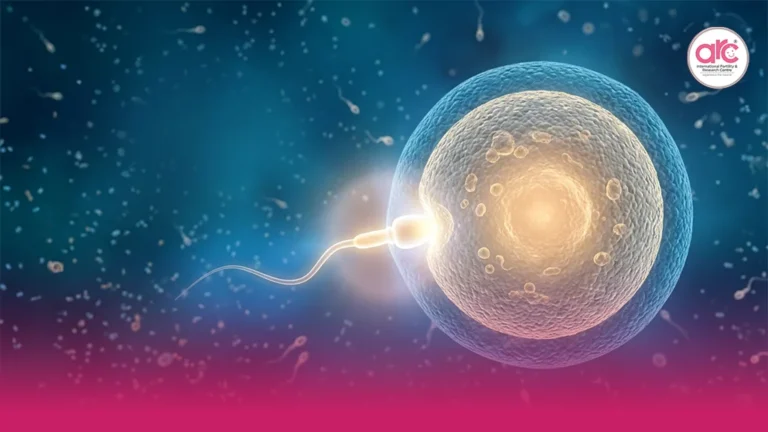
ICSI’s role ends at fertilisation. A single sperm is injected into the egg to overcome barriers like low count, poor motility, or abnormal morphology. Once fertilisation occurs, embryo development follows the same biological rules it always has.
The embryo does not know how it was fertilised.
What researchers believe may influence splitting includes factors such as extended culture to the blastocyst stage, changes in the embryo’s outer shell, assisted hatching, laboratory conditions, and the way embryos are handled during development. These factors relate to the environment around the embryo, not the act of ICSI itself.
In other words, ICSI does not “push” an embryo to divide. It simply helps fertilisation happen when nature needs support.
Why ICSI Is So Often Blamed
ICSI sounds invasive. That alone makes it easy to blame.
The image of a needle entering an egg stays in people’s minds, and from there, assumptions grow. If something this precise and artificial is involved, surely it must be increasing risks, right?
But fertilisation and embryo splitting are two very different stages.
ICSI helps sperm meet egg.
Splitting happens days later, during embryo development.
By the time an embryo even has the capacity to split, the ICSI procedure is long over. At that point, the embryo behaves according to its own biological programming. The lab does not instruct it to divide. The doctor does not influence that choice. The embryo decides on its own, just as it would inside the body.
The Role of Blastocyst Transfers
Here’s where science adds another layer.
Blastocyst-stage transfers, typically done on day five, are associated with a marginally higher rate of identical twinning. This is true across IVF and ICSI cycles alike.
Why does this happen? By the blastocyst stage, the embryo’s outer shell naturally thins. If an embryo is biologically inclined to divide, that thinner shell may make splitting physically easier.
But it’s important to keep perspective. Even with blastocyst transfers, identical twinning remains uncommon. The risk increases slightly, not dramatically. And for most couples, the benefits of blastocyst transfer, better implantation potential and improved selection, outweigh this small statistical change.
Should Couples Undergoing ICSI Be Worried About Twins?
Worry isn’t helpful. Awareness is.
Modern fertility practice has shifted decisively toward single embryo transfer, precisely to reduce multiple pregnancy risks. This approach protects maternal health, lowers pregnancy complications, and ensures more controlled outcomes.
A best fertility hospital in Chennai does not chase high numbers or dramatic success stories. It prioritises safety, sustainability, and long-term wellbeing. Twins may sound exciting in theory, but in medical reality, they carry higher risks for both mother and babies. That’s why prevention matters more than surprise.
How Advanced Technology Has Changed the Landscape
It’s also important to recognise how much fertility science has evolved.
Today’s embryology labs are highly controlled environments. Embryos are monitored carefully. Handling is minimised. Selection is guided by advanced imaging and data, not guesswork. Innovations like AI-assisted embryo assessment have refined decision-making and reduced unintended outcomes.
Articles such as How AI-Driven ICSI Is Changing Fertility Treatment explain how precision has replaced approximation in modern labs. This technological maturity matters. It means risks that once felt mysterious are now better understood and better managed.
The Bigger Picture Couples Often Miss
ICSI is not an unnatural shortcut. It is a response to a specific barrier. It allows fertilisation to happen where it otherwise wouldn’t, but it does not rewrite biology.
Embryos created through ICSI are not weaker. They are not fragile. They do not behave differently once development begins. They grow, divide, and implant according to the same internal logic as any other embryo.
Embryo splitting remains rare.
ICSI does not cause it directly.
And fear should never replace evidence.
For couples already carrying the emotional weight of infertility, clarity is not a luxury. It is a necessity. Understanding the science does not eliminate uncertainty, but it does remove unnecessary fear.
And in a journey that already demands so much patience, that matters more than people realise.