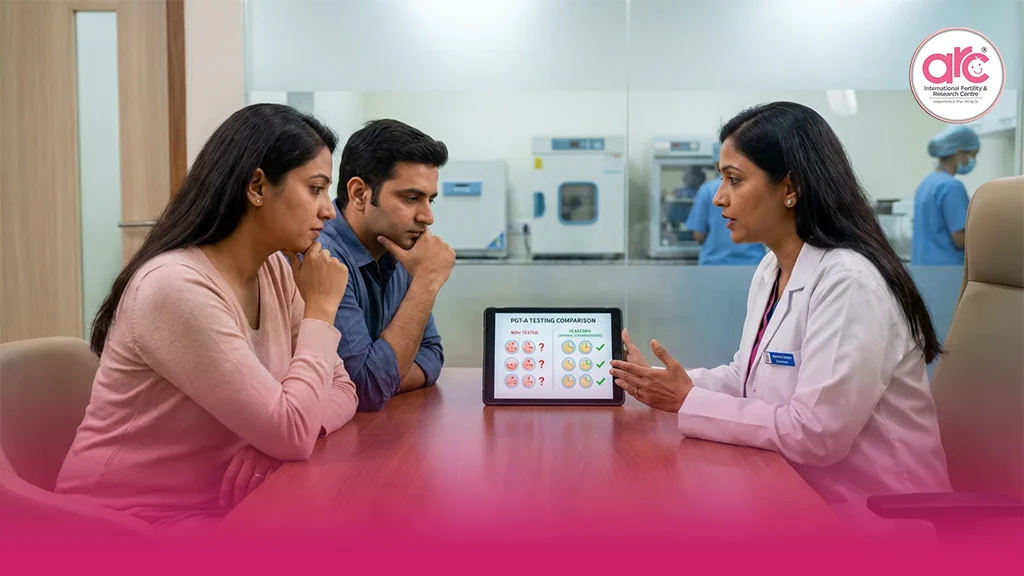
Overview
To test or not to test? The science, the cost, and the quiet controversy behind PGT-A embryo screening.
There’s a moment in almost every IVF journey when hope meets a spreadsheet.
You’re already emotionally invested. Physically tired. Financially stretched. And then the quote arrives. Medications. Procedures. Transfers.
And one line stands out.
PGT-A testing.
Optional. Expensive. Framed as reassurance.
You’re told it screens embryos for chromosomal problems. That it helps choose the “best” embryo. That it reduces miscarriage risk. That it might increase success.
Might.
And suddenly the question isn’t scientific. It’s personal.
Am I being careful, or am I being sold fear?
Let’s slow this down and talk honestly about what PGT-A testing can do, what it can’t, and who it actually helps.
What PGT-A Testing Is, in Plain Language
PGT-A, Preimplantation Genetic Testing for Aneuploidy, examines embryos created through IVF to check whether they have the correct number of chromosomes.
A chromosomally normal embryo has 46 chromosomes. Too many or too few often lead to failed implantation, miscarriage, or conditions incompatible with life.
The idea behind PGT-A testing is simple. Identify embryos that are chromosomally normal, transfer those, and avoid transferring embryos that are unlikely to succeed.
On paper, it sounds logical. Almost obvious.
But biology is rarely that tidy.
What PGT-A Testing Does Well
Let’s be fair. PGT-A has real strengths.
It can:
- Reduce the chance of transferring an embryo with obvious chromosomal abnormalities
- Lower miscarriage rates in certain groups
- Help prioritise embryos when many are available
- Shorten time to pregnancy for some patients
For women over 35, where chromosomal errors increase significantly with age, PGT-A often provides useful information. In cases of recurrent miscarriage linked to chromosomal issues, it can offer clarity that repeated heartbreak never could.
This is why many clinics, especially those offering advanced fertility treatment procedures, recommend it selectively, not universally.
Where the Debate Begins
The controversy isn’t about whether PGT-A works. It’s about who it works for and at what cost.
Large studies have shown that while PGT-A may improve implantation rates per transfer, it does not always increase overall live birth rates per IVF cycle, especially in younger women with fewer embryos.
In other words, testing may help choose which embryo to transfer, but it doesn’t necessarily create more babies from the same cycle.
This is where the question “is PGT-A worth it?” becomes complicated.
The Problem of Fewer Embryos
PGT-A requires embryos to reach the blastocyst stage and survive biopsy and freezing.
For women with:
- Low ovarian reserve
- Few embryos
- Borderline response to stimulation
PGT-A can sometimes reduce the number of embryos available for transfer.
Some embryos classified as abnormal may still have had the potential to self-correct and result in healthy pregnancies. This possibility, while not common, is real enough to matter when embryo numbers are limited.
This is why blanket recommendations can be harmful.
At a fertility hospital in Chennai, experienced specialists usually look at embryo count, age, and history before advising PGT-A, not just protocol.
Chromosomally Normal Does Not Mean Guaranteed
A chromosomally normal embryo transfer improves the odds. It does not guarantee implantation, pregnancy, or live birth.
Embryos still need:
- A receptive uterus
- Correct timing
- Adequate blood flow
- Immune balance
PGT-A cannot detect every genetic issue. It cannot predict epigenetic problems. And it cannot compensate for uterine or hormonal factors.
When patients believe PGT-A creates “perfect embryos,” disappointment can feel sharper when transfers still fail.
The Cost Conversation No One Likes Having
Let’s talk about money, because avoiding it doesn’t make it less real.
The genetic testing for embryos cost is often substantial. For many couples, it adds a significant percentage to the total IVF bill.
That cost needs to be weighed against:
- Age
- Number of embryos expected
- History of miscarriage
- Financial bandwidth
- Emotional readiness for multiple transfers
For some, PGT-A saves money by reducing failed transfers. For others, it adds cost without changing the final outcome.
There is no universal answer. And that’s what makes this decision heavy.
Who Benefits Most from PGT-A
PGT-A tends to be more helpful for:
- Women over 35
- Couples with recurrent pregnancy loss
- Cases with many embryos to choose from
- Situations where time to pregnancy is critical
It may be less helpful for:
- Younger women with few embryos
- First IVF cycles without prior losses
- Patients with financial constraints and limited embryos
The best fertility hospital in Chennai will never treat PGT-A as a checkbox. It should be a conversation, not an upsell.
Why Patients Feel Pressured
Patients are often told, “If you don’t test, you might be transferring a bad embryo.”
That sentence carries fear. And fear makes people say yes, even when unsure.
But informed consent requires more than statistics. It requires context.
The Question That Actually Matters
The real question isn’t “Does PGT-A work?”
It’s “Does PGT-A work for me, right now, in my situation?”
That answer depends on biology, not marketing.
The Bottom Line Couples Deserve to Hear
PGT-A testing is a tool. Not a guarantee. Not a requirement. Not a moral choice.
It can reduce uncertainty for some. It can add complexity for others.
In fertility, more technology doesn’t always mean better outcomes.
To test or not to test isn’t about being brave or cautious.
It’s about being informed.
And informed decisions are the only ones that truly support live birth, not just good intentions.