Overview
When a semen report says oligospermia, the room changes.
The doctor may explain calmly. The numbers may be circled neatly. But inside, something sinks. Low sperm count doesn’t just affect fertility. It touches masculinity, self-worth, and the unspoken fear of letting your partner down. Many couples leave the clinic asking the same question, sometimes aloud, sometimes only in their heads.
With sperm this low… is ICSI even possible?
The answer is not just yes.
The answer is this is exactly what ICSI was designed for.
At a fertility hospital in Chennai, some of the most successful ICSI cycles begin with semen reports that look hopeless at first glance. Because when it comes to ICSI, numbers matter far less than people think.
What Oligospermia Actually Means
Oligospermia means the sperm count is lower than the normal reference range. It does not mean there is no sperm. It does not automatically mean the sperm are abnormal. And it certainly does not mean pregnancy is impossible.
Many men with oligospermia still produce genetically healthy sperm. The issue is not quality alone. It is access. In natural conception or even IUI, sperm must travel, survive, and compete. With low numbers, that journey often fails before it begins.
ICSI changes that equation entirely.
Why ICSI Works When Sperm Count Is Low
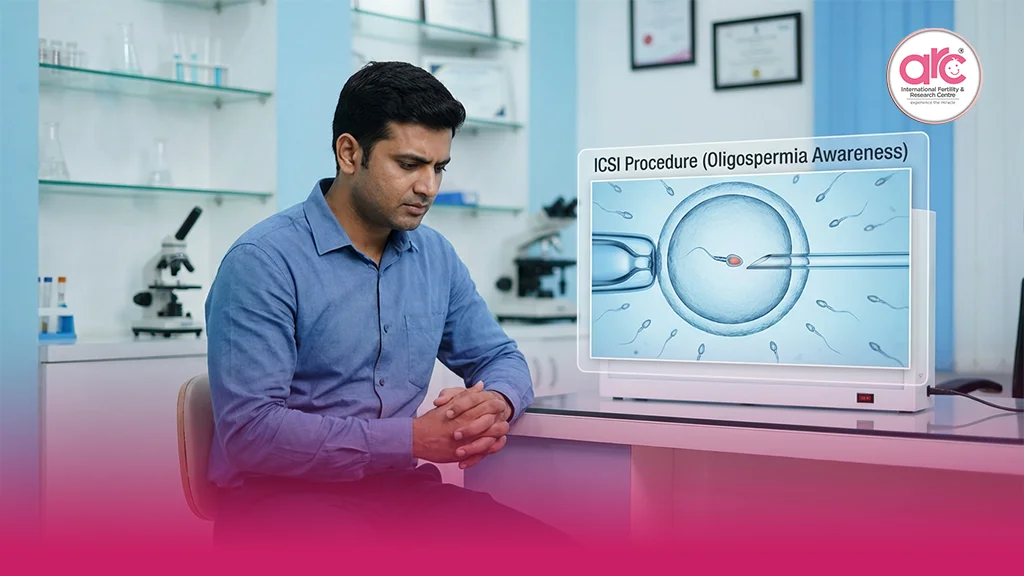
ICSI, Intracytoplasmic Sperm Injection, removes competition from the equation. Instead of asking millions of sperm to race toward an egg, embryologists carefully identify a single viable sperm and inject it directly into the egg.
One sperm is enough.
That is why even men with extremely low counts, sometimes just a few usable sperm in the entire sample, can still achieve fertilisation. In cases of severe oligospermia, sperm can even be retrieved directly from the testes using procedures like TESA or micro-TESE, and ICSI can still proceed successfully.
This is also why conventional IVF often fails in low-count cases. IVF still requires sperm to penetrate the egg on their own. ICSI does not. If you want clarity on this distinction, IVF vs ICSI — The Key Differences Explained lays out why the choice of technique matters so much when sperm parameters are compromised.
How Doctors Decide ICSI Is the Right Path
ICSI is not chosen simply because a count is low. Specialists look at the full picture.
They assess sperm movement, shape, DNA integrity, hormonal balance, infection markers, and any history of failed fertilisation. Sometimes the count fluctuates. Sometimes lifestyle changes help marginally. Sometimes they don’t.
What matters is timing. Waiting too long for improvement that may never come can quietly cost years.
This is why working with the best fertility hospital in chennai makes a difference. The decision to move toward ICSI is not about rushing. It is about recognising when precision is more valuable than persistence.
How Technology Has Transformed ICSI for Oligospermia
ICSI today is not what it was fifteen years ago.
Embryologists no longer rely only on visual judgment. Advanced tools now help identify sperm with better DNA integrity and lower fragmentation, even when overall numbers are poor. AI-assisted systems are increasingly guiding sperm and embryo selection, reducing human bias and improving consistency.
This evolution has been especially powerful for male-factor infertility. If you want to understand how this shift is happening, How AI-Driven ICSI Is Changing Fertility Treatment explains why technology has become an ally, not a replacement, in the lab.
For men with oligospermia, this means fewer wasted cycles and more informed choices.
What Couples Often Misunderstand
Many couples assume low sperm count means low success rates. Others delay treatment hoping numbers will rise naturally. Sometimes they do. Often, they don’t.
The real misunderstanding is this: ICSI does not need abundance. It needs accuracy.
If you are still deciding which treatment fits your situation, How to Choose Between IUI, IVF, or ICSI Based on Age and Sperm Health offers a realistic lens, especially when sperm count is declining with time.
The Truth That Matters Most
Oligospermia is not the end of fertility. For many couples, it is the moment when treatment finally becomes specific enough to work.
ICSI was created for precision.
Low sperm count demands precision.
And when the two meet at the right time, outcomes change.