Overview
It usually starts quietly.
A few coarse hairs on the chin that weren’t there before.
Acne that feels stubborn, deeper, angrier than teenage breakouts.
A sense that your face is changing in ways makeup can’t fully hide.
At first, it feels cosmetic. Annoying. Something to manage with tweezers, lasers, skincare routines.
But when these changes arrive alongside irregular periods, delayed ovulation, or difficulty getting pregnant, a deeper question surfaces.
What is my body trying to tell me?
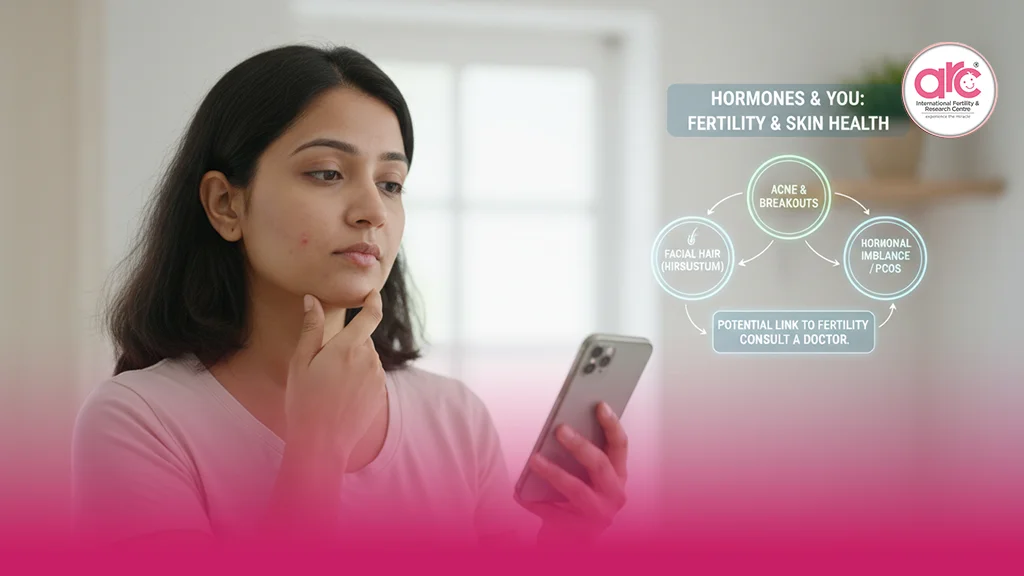
Sometimes, facial hair and acne aren’t just about appearance. They’re about hormones. And for many women, they’re early, visible signs of fertility disruption.
What Hirsutism Actually Is (And Why It’s Not Just Hair)
Hirsutism refers to excessive hair growth in areas typically associated with male-pattern hair, the chin, upper lip, chest, abdomen, or back.
This isn’t the soft peach fuzz most women have. This hair is darker, thicker, and keeps coming back no matter how often it’s removed.
Hirsutism isn’t caused by bad grooming or genetics alone. It’s driven by excess androgens, male hormones like testosterone, acting on hair follicles.
And when androgens rise, ovulation often falls.
That connection is the part most women aren’t told early enough.
The Acne That Feels Different
Hormonal acne linked to androgen excess doesn’t behave like typical breakouts.
It often:
- Appears along the jawline, chin, and lower cheeks
- Is deep, cystic, and painful
- Worsens before periods or during stress
- Persists well into adulthood
This acne reflects internal hormonal imbalance, not poor skincare.
When acne and hirsutism appear together, it’s often a signal that ovulation is being disrupted at the same time.
The PCOS Connection No One Explains Clearly
For many women, these signs trace back to one condition, polycystic ovary syndrome.
PCOS is not just about ovaries. It’s a metabolic and hormonal condition where:
- Androgens are elevated
- Ovulation becomes irregular or absent
- Insulin resistance is common
- Egg development is disrupted
Here’s the paradox that confuses so many women.
High androgens cause hair growth on the face and body, but they prevent the ovary from releasing eggs.
So while the body shows signs of “masculine” hormone excess, fertility quietly stalls.
At a fertility hospital in Chennai, many women arrive focused on hair and skin changes, only to discover that these visible signs were the earliest clues to an ovulation problem that had been developing for years.
Why Ovulation Stops When Androgens Rise
Ovulation is a delicate hormonal choreography.
Estrogen needs to rise gradually.
Follicles need time to mature.
The brain needs clear signals to trigger egg release.
Excess androgens interfere at multiple points:
- They disrupt follicle maturation
- They blunt estrogen signalling
- They alter feedback to the brain
The result is follicles that grow but don’t release eggs. Cycles may lengthen, become unpredictable, or disappear altogether.
From the outside, periods may still come. But ovulation may not.
This is why women with PCOS can menstruate and still struggle to conceive.
Why These Signs Are Often Dismissed
Many women are told:
- “It’s just cosmetic.”
- “Plenty of women have chin hair.”
- “Your acne will settle.”
And for a while, that reassurance holds.
But when pregnancy doesn’t happen, the same signs suddenly feel louder. In hindsight, they were clues, not inconveniences.
The best fertility hospital in Chennai looks at skin, hair, cycles, and metabolism together, not in isolation, because the body doesn’t compartmentalise symptoms the way medicine sometimes does.
The Emotional Weight of Visible Hormonal Changes
There’s a quiet shame that comes with these symptoms.
Women feel less feminine. Less confident. Less at home in their own bodies.
They hide tweezers. Avoid mirrors. Worry that something is “wrong” with them.
What’s wrong isn’t you. It’s the messaging.
Your body isn’t betraying you. It’s communicating.
What To Do If You’re Noticing These Changes
Facial hair and acne don’t automatically mean infertility. But they deserve attention, especially if combined with:
- Irregular cycles
- Delayed ovulation
- Weight changes that feel unexplained
- Difficulty conceiving
Evaluation often includes:
- Hormonal blood tests
- Ovulation tracking
- Metabolic assessment
- Ultrasound findings
The goal isn’t just to treat hair or acne. It’s to restore ovulation.
When ovulation returns, skin and hair often improve too, because the root cause is addressed.
Why Treating the Root Matters More Than Cosmetic Fixes
Laser hair removal, medications, and skincare can manage symptoms, but they don’t restore fertility on their own.
Ovulation returns when:
- Androgen levels are reduced
- Insulin sensitivity improves
- Hormonal feedback loops stabilise
This may involve lifestyle changes, targeted medication, or fertility treatment, depending on individual needs.
Understanding these symptoms is the first step; learn more about 7 Early Signs of Infertility in Women and Men to see how the body often signals trouble long before pregnancy attempts begin.
A Reframing That Changes Everything
Facial hair and acne are not failures of femininity.
They are signs of hormonal imbalance.
They are messages, not judgments.
When women stop seeing these changes as something to hide and start seeing them as information, the path forward becomes clearer.
A Grounding Truth to Hold Onto
Your body speaks before it struggles.
Sometimes it speaks through skin.
Sometimes through hair.
Sometimes through cycles that don’t behave as expected.
Listening early doesn’t make you anxious. It makes you informed.
If you’re noticing changes that feel out of character, trust that instinct. Ask deeper questions. Seek answers that connect the dots instead of covering them up.
Because fertility isn’t just about getting pregnant someday.
It’s about understanding your hormones today.
And when you understand what your body is saying, you stop fighting it.
You start working with it.