
Overview
The insulin–ovulation connection. Why balancing your blood sugar matters more than counting calories for PCOS.
For years, women with PCOS have been handed the same advice, usually wrapped in concern but delivered with bluntness.
Lose weight.
Exercise more.
Everything will fall into place.
And when weight loss doesn’t magically restore ovulation, the shame quietly turns inward.
Here’s the part that rarely gets explained properly.
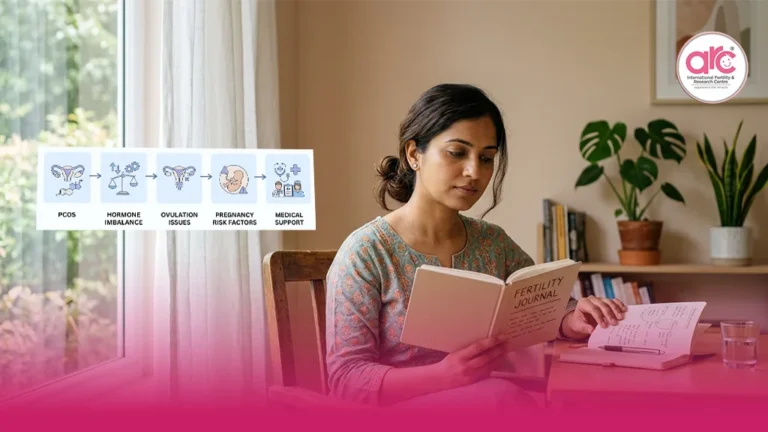
PCOS is not a weight problem. It’s a metabolic and hormonal one.
You can be thin and still not ovulate.
You can eat “clean” and still struggle to conceive.
You can do everything right and still feel stuck.
The missing piece for many women is insulin resistance, not the number on the scale.
What Insulin Resistance Actually Means in PCOS
Insulin is the hormone that helps move glucose from your blood into your cells so it can be used for energy.
When the body becomes resistant to insulin, it has to produce more of it to get the same job done. Blood sugar may still look “normal,” but insulin levels are working overtime behind the scenes.
In PCOS, this excess insulin doesn’t just affect metabolism. It directly interferes with the ovaries.
High insulin stimulates the ovaries to produce more androgens, male-type hormones. Those androgens disrupt follicle development. Eggs start to grow, but they don’t mature properly. Ovulation stalls.
This is why insulin resistance and fertility are so tightly linked in PCOS, regardless of body size.
Why Ovulation Stops Even at a ‘Healthy’ Weight
One of the most harmful myths around PCOS is that weight alone determines fertility.
In reality, many lean women with PCOS have significant insulin resistance. They don’t fit the stereotype, so their symptoms are often dismissed or delayed.
But insulin doesn’t care about clothing size.
When insulin remains chronically high, the ovaries receive constant mixed signals. Hormones that should rise and fall instead stay flat or chaotic. Ovulation becomes unpredictable or disappears altogether.
This is why so many women search desperately for PCOS ovulation help, trying supplements, cycle tracking, and ovulation kits that never quite line up with reality.
PCOS Is a System Issue, Not a Single Hormone Problem
PCOS doesn’t live in isolation.
It’s part of a wider network, metabolism, stress hormones, inflammation, sleep rhythm, and ovarian signaling all interacting at once. This is why treating PCOS as “just irregular periods” rarely works.
If insulin resistance isn’t addressed, ovulation-inducing medications may work temporarily but fail long-term. Egg quality may suffer even when cycles resume.
Understanding PCOS through the lens of Your Hormone Ecosystem changes the approach entirely. Instead of forcing ovulation, the focus shifts to restoring internal balance so ovulation can happen naturally or respond better to treatment.
How Insulin Resistance Affects Egg Quality
This is a conversation many women don’t hear early enough.
High insulin levels create an inflammatory environment around the ovaries. That environment affects how eggs mature, how they respond to fertilisation, and how embryos develop afterward.
Poor PCOS egg quality isn’t a personal failure. It’s a biological consequence of metabolic stress.
This is why some women with PCOS ovulate but still struggle with implantation or early miscarriage. The issue isn’t just releasing an egg. It’s releasing a healthy one.
Where Metformin Fits, and Where It Doesn’t
Metformin is often prescribed for PCOS because it improves insulin sensitivity. For some women, it helps regulate cycles, restore ovulation, and improve response to fertility treatments.
But metformin for fertility is not a magic fix.
It works best when combined with lifestyle rhythm changes, not when used as a standalone solution. Without addressing sleep, stress, meal timing, and inflammation, metformin can feel like a partial answer to a full-body problem.
At a fertility hospital in chennai, clinicians increasingly use metformin as one tool among many, not the entire strategy.
Why ‘Eat Less, Move More’ Often Backfires
Chronic calorie restriction and excessive exercise can worsen insulin resistance in some women with PCOS, especially when stress hormones rise as a result.
Skipping meals.
Overtraining.
Living in a constant deficit.
These strategies may reduce weight temporarily but increase cortisol, which further disrupts insulin and ovulation.
Balancing blood sugar requires steadiness, not punishment.
Regular meals.
Adequate protein.
Gentle movement.
Consistent sleep.
These aren’t lifestyle clichés. They’re metabolic signals.
When Fertility Treatment Is Added to the Mix
Women with PCOS often respond strongly to fertility medications. Sometimes too strongly. Insulin resistance amplifies that response, increasing the risk of poor-quality follicles or overstimulation.
This is why personalised protocols matter.
The best fertility hospital in chennai doesn’t treat PCOS with a single formula. It adjusts stimulation based on insulin status, ovarian response, and metabolic health, not just age or weight.
When insulin resistance is addressed first, fertility treatments often become more predictable and gentler on the body.
The Emotional Weight of Being Misunderstood
Perhaps the hardest part of PCOS is not the diagnosis. It’s the judgment.
Being told your body is “not cooperating.”
Being blamed for something you didn’t cause.
Being reduced to a number on a scale.
Insulin resistance is invisible. But its effects are real.
Understanding this shifts the narrative from self-blame to self-awareness.
The Truth PCOS Patients Deserve
PCOS is not a character flaw.
It is not laziness.
It is not solved by willpower alone.
It is a metabolic condition that interferes with ovulation, egg quality, and fertility, even in women who appear healthy by conventional standards.
Balancing insulin isn’t about shrinking yourself.
It’s about supporting the biology that allows reproduction to happen.
When blood sugar stabilises, hormones follow.
When hormones align, ovulation returns.
And when ovulation becomes consistent, fertility has space to grow.
Beyond the scale, that’s where real progress begins.