Overview
When fertility treatment begins, most patients expect injections, scans, and hormone discussions.
What they don’t expect is a warning about movement.
Doctors suddenly say things like:
Avoid running.
Avoid jumping.
Avoid heavy lifting.
For women who exercise regularly, these instructions can feel overly cautious.
But they exist for a very specific medical reason.
During ovarian stimulation, the ovaries temporarily become much larger than usual. And when enlarged ovaries move too suddenly, they can twist.
That twist is called ovarian torsion, and it is one of the rare but serious complications doctors work hard to prevent.
Why Ovaries Enlarge During Fertility Stimulation
In a natural menstrual cycle, the ovary typically develops one dominant follicle.
During IVF or egg freezing stimulation, medications encourage the ovaries to mature multiple follicles at the same time.
Instead of one egg developing, the ovaries may contain 10, 15, or even more follicles.
Each follicle is filled with fluid and grows to around 18–22 mm before ovulation or retrieval.
As a result, the ovaries become significantly larger and heavier than normal.
At a fertility hospital in chennai, doctors monitor this growth carefully through ultrasound scans to ensure follicles develop safely before egg retrieval.
What Is Ovarian Torsion?
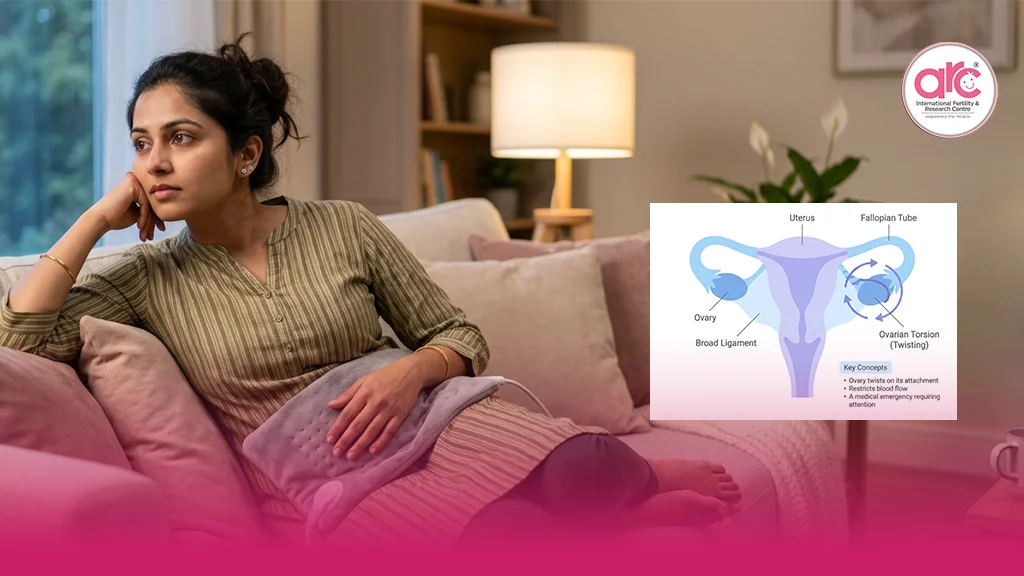
Ovarian torsion occurs when the ovary twists around its supporting ligaments.
These ligaments carry the blood vessels that supply oxygen and nutrients to the ovary.
When the ovary twists, blood flow becomes restricted.
If the twisting continues without treatment, the ovary may lose its blood supply and become damaged.
This is why ovarian torsion is considered a medical emergency.
Although rare, it requires immediate attention if symptoms appear.
Why Enlarged Ovaries Increase the Risk
Normally, ovaries are small and stable.
During stimulation, they become heavier and more mobile.
The additional weight increases the chance that the ovary may rotate within the pelvic cavity.
Sudden movements, high-impact exercise, or intense abdominal pressure can sometimes trigger this rotation.
The best fertility hospital in chennai usually advises patients to modify physical activity during stimulation specifically to reduce this risk.
These precautions are temporary but important.
Symptoms of Ovarian Torsion
Ovarian torsion often presents with sudden symptoms.
The most common include:
• Sharp or severe lower abdominal pain
• Pain on one side of the pelvis
• Nausea or vomiting
• Abdominal tenderness
• Difficulty standing or walking due to pain
The pain may come and go initially, then become constant.
If these symptoms appear during a stimulation cycle, contacting the clinic immediately is critical.
Early intervention can prevent damage to the ovary.
How Common Is Ovarian Torsion?
Fortunately, ovarian torsion is rare.
Studies estimate it occurs in less than 1% of IVF stimulation cycles.
Even though the risk is small, doctors take it seriously because untreated torsion can affect ovarian health and future fertility.
Preventive guidance helps reduce the chances even further.
Why Doctors Restrict Certain Movements
Movement restrictions during stimulation often surprise patients.
Activities that involve sudden motion, jumping, twisting, or intense abdominal pressure may increase the risk of ovarian torsion.
These include:
• Running or sprinting
• High-impact workouts
• Heavy weightlifting
• Intense core exercises
• Contact sports
Protecting your ovaries during the stimulation phase is critical, which is why we answer the common question: Can Intense Exercise Like Weightlifting Lower Your IVF Success Rates?
Understanding the medical reason behind these restrictions helps patients follow them with confidence rather than frustration.
Safe Activities During Stimulation
Movement is not completely restricted.
Gentle activity can still support circulation and emotional wellbeing.
Safer options usually include:
• Light walking
• Gentle stretching
• Slow yoga without twisting poses
• Relaxation exercises
These activities avoid sudden pelvic movement while allowing the body to stay active.
Your doctor may provide personalized guidelines depending on how large the ovaries become during stimulation.
What Happens If Torsion Occurs?
If ovarian torsion is suspected, doctors usually perform imaging tests such as ultrasound to assess blood flow.
Treatment may require laparoscopic surgery to untwist the ovary.
When treated early, the ovary often recovers completely.
The goal is always to restore blood flow as quickly as possible to protect ovarian tissue.
This is why recognizing symptoms early is so important.
A Balanced Perspective
Ovarian torsion sounds frightening, but it remains uncommon.
The activity restrictions during stimulation are preventive measures designed to protect enlarged ovaries during a temporary phase of treatment.
Once egg retrieval is completed and the ovaries shrink back to normal size, most women can gradually return to their usual physical routines.
Fertility treatment asks the body to do something extraordinary for a short period of time.
Protecting the ovaries during that window ensures the safest path toward the goal every patient hopes for — a healthy pregnancy.