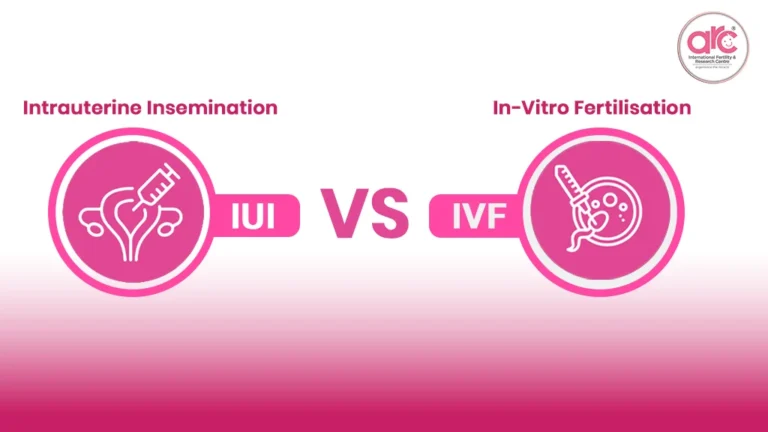

Overview
The hardest part of fertility treatment is not the injections or the scans.
It’s knowing when to stop repeating something that almost works.
IUI feels gentle. Familiar. Less intimidating. For many couples, it’s the first medical step after months of trying naturally. And because it’s simpler, cheaper, and less invasive, people tend to hold on to it longer than they should.
One more cycle.
Maybe next month.
Let’s not rush into IVF yet.
But fertility is not just about hope. It’s about timing. And there comes a point where continuing IUI isn’t patience anymore. It’s delay.
Why Couples Stay with IUI for Too Long
IUI feels like a halfway step. It doesn’t demand as much emotionally or financially as IVF. There’s also a psychological comfort in staying close to “natural” conception.
Many couples fear that moving to IVF means admitting failure. Others worry about complexity, cost, or the intensity of the process. So they repeat IUI cycles, hoping probability will eventually bend in their favour.
Sometimes it does. Often, it doesn’t.
At a fertility hospital in chennai, doctors frequently meet couples who have already done three, four, even six IUIs before asking the real question: Should we have moved on earlier?
What IUI Can and Cannot Fix
IUI works best when the basics are already in place.
It can help with mild male-factor issues, timing problems, or unexplained infertility where everything else looks normal. It improves the chances slightly by placing sperm closer to the egg at the right time.
But IUI cannot overcome significant barriers.
It doesn’t fix blocked tubes.
It doesn’t bypass severe sperm issues.
It doesn’t address egg quality decline.
It doesn’t control fertilisation or embryo development.
Once these factors are in play, repeating IUI doesn’t increase success meaningfully. It just consumes time.
The Age Factor That Changes Everything
Age is the quiet pressure most couples underestimate.
For women under 30, trying a few IUIs makes sense if everything else looks favourable. But as age crosses 32, and especially 35, the window narrows faster than most people expect.
Egg quality declines silently. Cycles still come. Reports may still look “acceptable.” But the margin for error reduces.
At this stage, IVF isn’t about escalation. It’s about efficiency.
The difference becomes clearer when you look at the difference between IUI and IVF success rates. IVF doesn’t just increase chances per cycle, it compresses time, something age-sensitive fertility cannot afford to lose.
How Many IUIs Are Reasonable?
This is where honesty matters.
Most evidence suggests that if IUI is going to work, it usually does within three cycles. Occasionally four. Beyond that, success rates flatten significantly.
If you’ve completed:
- 3 IUIs with no pregnancy
- or 2 IUIs with poor response
- or IUIs with worsening parameters
…it’s time to reassess, not repeat.
Continuing IUI beyond this point often reflects emotional hesitation rather than medical logic.
When IVF Is the Smarter Next Step
IVF is not just “stronger IUI.” It’s a different strategy entirely.
IVF allows doctors to:
- Retrieve multiple eggs in one cycle
- Control fertilisation directly
- Observe embryo development
- Select embryos with better potential
- Bypass tubal or sperm barriers
It turns guesswork into visibility.
Couples with endometriosis, tubal issues, significant male-factor infertility, low ovarian reserve, or repeated IUI failure often benefit from IVF not because IUI was wrong, but because IVF matches their biology better.
This is where the best fertility hospital in chennai makes a difference. The decision isn’t about pushing treatment. It’s about aligning method with reality.
The Emotional Cost of Waiting Too Long
What doesn’t get discussed enough is emotional fatigue.
Each failed IUI carries hope, expense, and recovery. Repeating that cycle over and over quietly drains resilience. By the time couples finally move to IVF, they’re already exhausted, emotionally and financially.
Ironically, IVF often works better when people arrive with clarity rather than burnout.
Choosing IVF earlier doesn’t mean giving up. It often means choosing a path with fewer emotional loops.
Cost Fear vs Cost Reality
Many couples delay IVF due to cost concerns. That fear is valid. But repeated IUIs also cost money, time, and emotional bandwidth.
Three or four IUIs that lead nowhere often end up costing more than one well-planned IVF cycle, especially when you factor in delayed outcomes.
Cost should be evaluated as cost per outcome, not cost per attempt.
How to Know You’re Ready to Move On
- You’re likely ready to move from IUI to IVF if:
- You’re repeating cycles without improved outcomes
- Age is no longer on your side
- Doctors are “hoping” more than explaining
- You feel stuck rather than informed
- You want answers, not just attempts
Moving to IVF is not a declaration of severity. It’s a decision to stop relying on probability alone.
The Truth Most Couples Need to Hear
IUI is not meant to be indefinite. It’s a step, not a destination.
IVF is not a failure of simpler methods. It’s a response to clearer understanding.
The goal isn’t to do everything slowly.
The goal is to do the right thing at the right time.
If IUI hasn’t worked after reasonable attempts, continuing doesn’t make you patient. It makes you hopeful without strategy.
And fertility deserves better than hope alone.