Overview
There’s a belief floating around gyms, WhatsApp groups, and even some clinics that testosterone is the answer to male fertility.
Low energy? Take testosterone.
Low libido? Take testosterone.
Trying for a baby and want to “boost masculinity”? Take testosterone.
It sounds logical on the surface. Testosterone equals manhood. Manhood equals sperm. More testosterone should mean more sperm, right?
Wrong.
In reality, testosterone and sperm count have an inverse relationship when testosterone is taken from outside the body. And this misunderstanding has quietly pushed many men into temporary, sometimes prolonged, infertility.
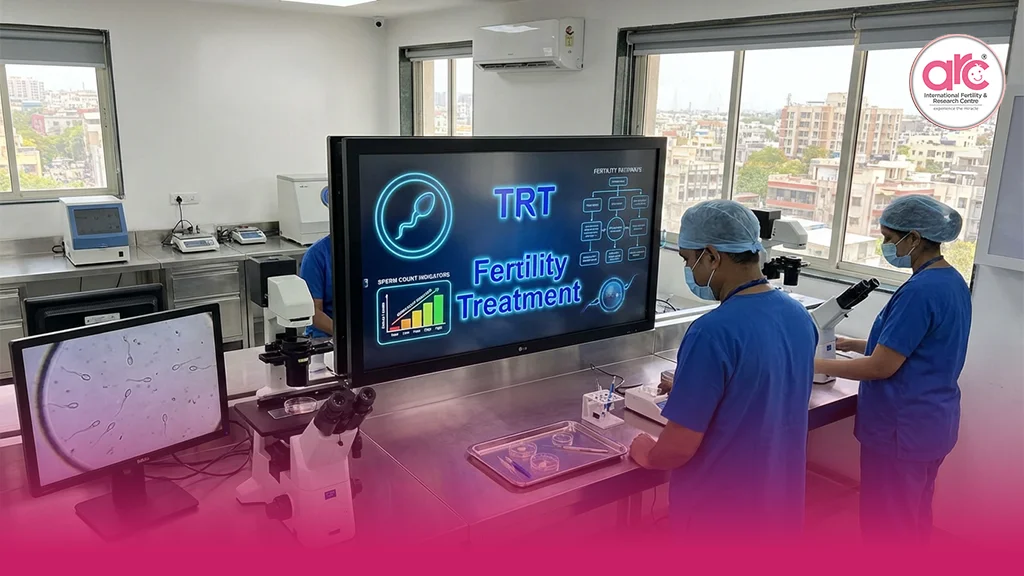
Testosterone Replacement Therapy, or TRT, is not a fertility treatment. In many cases, it functions like male birth control.
Where the Confusion Begins
Testosterone is essential for sperm production. That part is true.
But here’s what most men aren’t told clearly enough: the testosterone that supports sperm production is made inside the testes, not injected through a syringe, patch, gel, or pill.
When you take external testosterone, your brain gets a signal that says, “We have enough. Stop producing.”
And the first thing your body stops producing isn’t testosterone.
It’s sperm.
At a fertility hospital in chennai, doctors regularly see men who started TRT for fatigue, muscle gain, or “low T,” only to discover months later that their sperm count has dropped drastically, sometimes to zero. A condition called azoospermia.
How TRT Actually Works Inside the Body
Your reproductive system runs on a feedback loop.
The brain signals the pituitary gland.
The pituitary signals the testes.
The testes produce testosterone and sperm together.
When external testosterone enters the system, that loop shuts down.
The pituitary stops sending signals.
The testes go quiet.
Sperm production slows… then stops.
This is why TRT has been studied as a potential male contraceptive. Not because it’s toxic. But because it’s effective at suppressing sperm production.
So when men ask whether testosterone improves fertility, the honest answer is this: TRT often does the opposite of what you want if you’re trying to conceive.
Why Men Still Believe Testosterone Helps Fertility
Because the effects feel good at first.
Energy improves.
Muscle mass increases.
Libido often rises.
It’s easy to assume fertility must be improving too.
But sperm production doesn’t announce its shutdown with pain or obvious symptoms. It just… fades. Quietly. By the time a semen analysis is done, the surprise hits.
This is why the relationship between testosterone and sperm count is one of the most misunderstood topics in male fertility.
Feeling more “manly” does not mean being more fertile.
The Long-Term Cost of Short-Term Fixes
For some men, stopping TRT allows sperm production to recover within months. For others, especially after long-term use, recovery is slower and less predictable.
Age matters. Duration matters. Baseline fertility matters.
This is why responsible clinics, especially the best fertility hospital in chennai, always ask a critical question before starting testosterone therapy:
Do you want children now, or might you want them later?
If the answer is yes, TRT should never be the first option.
What Men Actually Need When Sperm Count Is Low
Low testosterone symptoms and low sperm count are not the same problem, even though they’re often lumped together.
Men with fertility goals may benefit from treatments that stimulate the body to produce its own testosterone, rather than replacing it externally. These approaches support both hormonal balance and sperm production.
This distinction is crucial. Testosterone therapy replaces. Fertility-focused treatment restores.
Confusing the two can cost time, money, and emotional resilience.
The Deeper Conversation TRT Avoids
There’s another layer men don’t often hear about.
Sperm isn’t just about numbers. It carries biological information influenced by a man’s health, fitness, stress levels, and metabolism. Research discussed in How a Father’s Fitness May Be Quietly Passed Down Through Sperm shows that sperm quality reflects how a man is living, not just his hormone levels.
TRT can mask deeper issues instead of addressing them.
Poor sleep.
Chronic stress.
Metabolic imbalance.
Lifestyle inflammation.
These affect both testosterone production and sperm health. Replacing testosterone without fixing the foundation is like turning up the music instead of fixing the engine noise.
Why This Matters Emotionally, Not Just Medically
Many men start TRT during a vulnerable phase.
They’re tired.
They feel less like themselves.
They want control back.
Testosterone promises that control.
But fertility doesn’t respond well to shortcuts. It responds to alignment.
Men often come in shocked, confused, sometimes ashamed, when they learn that the very treatment they took to “improve” themselves has put pregnancy plans on hold.
This isn’t about blame.
It’s about missing information.
Who TRT Is Actually For
TRT has a valid role.
Men with clinically confirmed hypogonadism who have completed their family may benefit significantly from testosterone therapy under proper supervision.
But TRT is not a solution for men who want to conceive now or in the future. And it should never be started casually, without a clear conversation about fertility.
The Bottom Line Men Need to Hear Clearly
Testosterone is essential for sperm production.
External testosterone shuts sperm production down.
That contradiction is the heart of the problem.
If you’re trying for a baby, or even thinking about trying in the next few years, testosterone therapy is not your friend. It doesn’t boost fertility. It often pauses it.
Strength, vitality, and masculinity are not measured by how much testosterone you inject. They’re reflected in how well your body can function without silencing itself.
Fertility isn’t about forcing the system.
It’s about working with it.
And when men finally understand the real relationship between testosterone and sperm count, they stop chasing the wrong fix, and start choosing the right one.