Overview
She had been told her ovarian reserve was too low for IVF to work well.
AMH barely registered. Antral follicle count of two. Three failed stimulation cycles that produced fewer eggs than expected.
Then her doctor mentioned something she had not heard of before.
PRP (Platelet-rich plasma) – injected directly into the ovaries.
“Is this real?” she asked. “Can it actually help?”
It is one of the most important questions in reproductive medicine right now. Uterine and Ovarian PRP: Can regenerative therapy reverse fertility aging? The science is emerging, the results are genuinely promising in some populations and the honest picture is more nuanced than either the enthusiasts or the sceptics acknowledge.
Here is what the research actually says and what it means for women at ARC who are exploring every option.
What Is PRP and Why Is It Being Used in Fertility?
PRP (platelet-rich plasma) is not a new concept in medicine.
It has been used in orthopaedics to heal tendons, in dermatology to rejuvenate skin and in wound care to accelerate tissue repair for over two decades. What makes PRP relevant to fertility is the same biological mechanism that makes it relevant everywhere else. It’s the concentration of growth factors.
PRP is an autologous concentration of platelets suspended in plasma that is enhanced with cytokines and growth factors to promote tissue regeneration and repair. There is growing interest in its use in reproductive medicine, specifically for ovarian reactivation.
Autologous means, it comes from your own blood. A small blood sample is taken, centrifuged to concentrate the platelets and growth factors and the resulting plasma is then injected, either into the ovarian tissue or the uterine cavity, depending on the target.
The logic is this. “If growth factors can stimulate tissue repair and regeneration elsewhere in the body, can they do the same for aging or damaged reproductive tissue?”
Increasingly, with appropriate caveats, the answer appears to be: sometimes, in specific populations, yes.
Ovarian PRP: What the Research Shows?
Intraovarian platelet-rich plasma has emerged as a novel intervention at the intersection of reproductive medicine and regenerative biology. As women with diminished ovarian reserve, poor response to stimulation or premature ovarian insufficiency seek fertility solutions, PRP provides a scientifically plausible, yet exploratory strategy to restore or augment ovarian function.
The proposed mechanisms are specific and biologically credible.
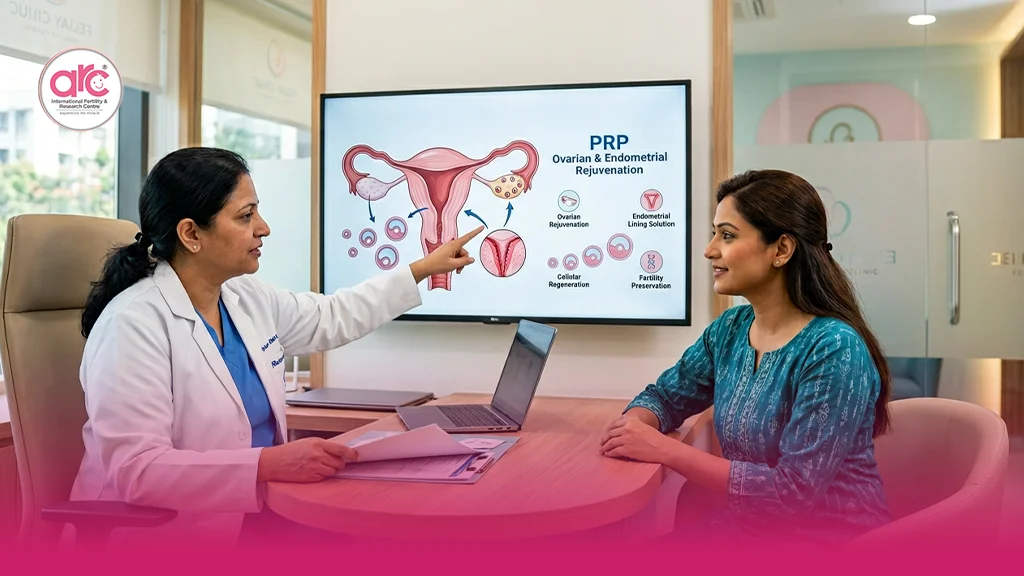
The proposed pathways include the stimulation of local stem cells, tissue remodelling, neoangiogenesis and the potential reawakening of dormant follicles.
In plain terms: PRP may stimulate dormant follicles that have not yet been lost but have also not been responding to conventional stimulation to become active. It may improve blood supply to the ovarian tissue. And it may create a more supportive local environment for whatever follicular activity remains.
While widely used in other medical fields, PRP therapy has recently emerged as a promising approach, offering potential for ovarian rejuvenation and improved fertility outcomes.
But the honest caveat matters here.
A double-blind randomised controlled trial found no statistically significant difference in ovarian reserve, fertilisation rates or pregnancy outcomes between those who received PRP and those who did not, despite small numerical differences in the observed data favouring PRP.
PRP has demonstrated potential benefits in reproductive medicine. However, further investigations are needed to evaluate its long-term effects on ovarian function and fertility outcomes and to optimise treatment protocols and establish standardised preparation methods.
The summary: Ovarian PRP shows genuine biological rationale and promising early results in specific groups, particularly women with diminished ovarian reserve and premature ovarian insufficiency. But it is not yet established as a standard-of-care treatment. It is best understood as a targeted option for women who have limited alternatives and a specialist who knows how to apply it appropriately.
Understanding how ovary size and function relate to your overall fertility picture is an important part of this conversation. Our guide on ovary size and fertility explains what the measurements mean and how they connect to treatment decisions.
Uterine PRP: Where the Evidence Is Stronger?
If ovarian PRP is the more debated application, uterine PRP injected into the uterine cavity to improve endometrial receptivity has a more consistent body of supporting evidence.
PRP was infused into the uterine cavity between cycle days 10 and 15, with repeat doses if endometrial thickness remained below 7 mm. Across 133 cycles and 211 infusions, PRP significantly increased median endometrial thickness from 6.7 to 7.6 mm, with most patients responding after a single infusion. Compared to patients’ prior non-PRP cycles, biochemical pregnancy rates improved from 35.5% to 48.3%, clinical pregnancy rates from 20.2% to 37.1% and live birth rates from 2.9% to 19.6%, while miscarriage rates decreased.
Those are not marginal improvements. They are clinically meaningful shifts in outcome for women who had previously failed to respond to conventional endometrial preparation.
The authors concluded that intrauterine PRP enhances endometrial thickness and improves implantation and live birth rates in difficult infertility populations.
Autologous PRP improved the implantation efficacy of embryo-endometrium synchronisation in patients with recurrent implantation failure. Clinical trials involving PRP interventions demonstrated improved outcomes for endometrial features and pregnancy.
Uterine PRP is most clearly indicated for women with a persistently thin endometrial lining, below 7 mm despite standard estrogen preparation and women with recurrent implantation failure where the uterine environment is suspected to be contributing to the repeated losses.
For a comprehensive overview of the full range of treatments available for uterine-factor infertility, our guide on fertility treatments for uterine infertility covers the complete picture, including where PRP fits within the broader treatment landscape.
Uterine and Ovarian PRP: Who Is the Right Candidate at ARC?
Uterine and ovarian PRP: Can regenerative therapy reverse fertility aging for everyone? No!
But for specific, well-defined groups, it offers a genuinely evidence-informed additional option within an IVF or fertility treatment plan.
Uterine PRP is most appropriate for:
- Women with a persistently thin uterine lining despite standard hormonal preparation
- Women with recurrent implantation failure, two or more failed transfers with good-quality embryos
- Women with Asherman’s syndrome or intrauterine adhesions affecting endometrial response
- Women with unexplained implantation failure where the uterine environment is suspected
Ovarian PRP may be considered for:
- Women with confirmed diminished ovarian reserve who have responded poorly to conventional stimulation
- Women with premature ovarian insufficiency exploring fertility options before donor egg consideration
- Women who have had multiple poor-response IVF cycles and wish to attempt one further stimulation before moving to donor eggs
At ARC, the decision to use PRP is made in the context of a complete fertility evaluation, not as a standalone treatment offered without investigation. AMH, antral follicle count, endometrial thickness measurements and a full cycle history inform whether PRP is appropriate, when in the treatment cycle it should be applied and what outcome it is realistically being asked to achieve.
What to Expect From the PRP Procedure at ARC?
Both uterine and ovarian PRP are outpatient procedures.
For uterine PRP, blood is drawn, centrifuged to concentrate the platelets and the resulting plasma is gently infused into the uterine cavity, a process similar in feel to an embryo transfer. It takes approximately 15 to 20 minutes. No general anaesthesia is required.
For ovarian PRP, the procedure is done under mild sedation, similar to an egg retrieval. A fine needle is used to inject the PRP directly into the ovarian tissue under ultrasound guidance. Most women resume normal activities within 24 hours.
According to PMC’s 2025 systematic review on PRP in reproductive medicine, the procedure is considered safe with no significant adverse events reported across published clinical studies, making its risk profile acceptable even as the evidence base continues to develop.
The Honest Picture at ARC
Regenerative therapy for fertility is not science fiction. Nor is it a guaranteed solution.
It sits in a space where medicine navigates carefully, emerging evidence, clear biological rationale, meaningful results in selected populations and an ongoing need for larger, standardised trials before it becomes standard protocol.
At a dedicated fertility hospital in Chennai, PRP at ARC is offered within the context of a thorough evaluation and an honest conversation, what your specific situation is, what the realistic expectations from PRP are and where it fits within the broader treatment plan being built around your biology.
Because the goal at ARC is never to offer hope without evidence.
It is to offer every option the evidence supports, clearly explained, appropriately timed and delivered with the clinical precision that complex fertility cases deserve.
At the best fertility hospital in Chennai, that is the standard every patient at ARC receives, including those exploring regenerative therapies for whom conventional pathways have not yet produced the outcome they came for.
PRP will not reverse time.
But for some women, in the right clinical context, it may create just enough biological opportunity for the journey to continue.
That is not a small thing.
Frequently Asked Questions
Q1. What is PRP and how is it used in fertility treatment?
PRP (platelet-rich plasma) is a concentration of your own blood’s growth factors, injected into the uterus or ovaries to stimulate tissue regeneration and improve the fertility environment. It is used most commonly for thin uterine lining and diminished ovarian reserve.
Q2. Does Ovarian PRP increase egg count?
It may improve the ovarian environment and potentially activate dormant follicles in women with diminished ovarian reserve, but it does not reliably increase egg count in all women. The evidence is promising but not yet conclusive across all patient groups.
Q3. Is uterine PRP better proven than ovarian PRP?
Yes, uterine PRP has a stronger and more consistent evidence base, particularly for improving endometrial thickness and live birth rates in women with recurrent implantation failure or persistently thin lining despite hormonal preparation.
Q4. How many PRP sessions are needed for fertility treatment?
Most clinical protocols involve 1-2 sessions, with a repeat infusion if endometrial response is insufficient after the first. Your ARC specialist will determine the timing based on your cycle monitoring and endometrial measurements.
Q5. Is PRP safe for fertility treatment?
Yes, since PRP uses your own blood, the risk of allergic reaction or rejection is essentially zero. Published clinical studies to date have not reported significant adverse events, making it a low-risk addition to a fertility treatment plan when applied appropriately.