
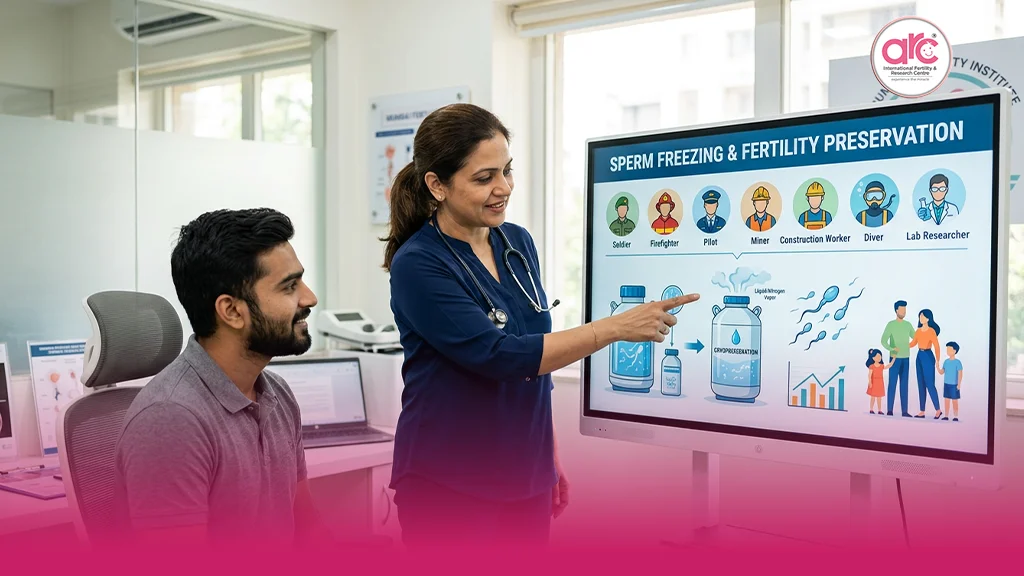
Overview
He had been meaning to think about it for years.
Thirty-four, married, working as an electrician on large construction sites – long hours, heavy equipment, chemicals and heat that most people never consider as factors in reproductive health.
His wife had started asking questions about starting a family. He had started asking different questions.
“Is my job affecting my sperm?”
It is a question more men are asking and not asking often enough. Who needs sperm freezing? The conversation has long centred on illness, on cancer treatment, on medical necessity. But a growing body of research is making clear that certain careers carry daily, cumulative exposure to hazards that meaningfully reduce sperm quality over time.
For men in these professions, sperm freezing is not a medical emergency.
It is a proactive, intelligent reproductive decision, one that could matter enormously later.
Why Does Occupation Affect Sperm More Than Most Men Realise?
Sperm are among the most environmentally sensitive cells in the human body.
Both male and female workers can become sterile or experience decreased fertility from exposure to radiation or certain chemicals. Damage to the male germ cells can cause abnormal sperm to be produced. It can also reduce the number of sperm that are produced to a level below the minimum necessary for fertilisation to be likely.
The three primary occupational threats to sperm are heat, chemicals and radiation.
Fertility problems due to workplace exposures can affect both men and women. These problems may lead to hormonal imbalances, a decrease in sperm quality and disruption of menstrual cycles.
The damage is rarely sudden. It accumulates, year after year of exposure, cycle after cycle of sperm production happening in a compromised environment.
Sperm takes approximately 74 days to develop. That means the sperm produced today reflects the conditions your body has been in for the past two and a half months. If those conditions include heat, chemical exposure or radiation, the sperm quality reflects that.
Who Needs Sperm Freezing? 7 High-Risk Jobs Listed By ARC
Who needs sperm freezing? Here are the seven occupational categories where the evidence most consistently points to elevated reproductive risk and where sperm freezing is worth considering proactively.
i) Construction and Heavy Industry Workers
Construction sites combine three of the most damaging fertility factors: heat, vibration and chemical exposure.
Vibrations: Frequent exposure to vibrations, such as those experienced by heavy machinery operators or drivers, can have a negative impact on sperm health. Research suggests that long-term exposure to vibrations can cause sperm abnormalities and reduce fertility potential.
Welders, electricians, painters and labourers are regularly exposed to lead, benzene, toluene and solvents, chemicals documented to reduce sperm count, motility and morphological integrity over sustained exposure.
ii) Professional Drivers and Long-Haul Transport Workers
Occupations such as truck driving, long-haul flights or jobs that require prolonged sitting can negatively impact male fertility. Physical strain: Jobs that involve prolonged sitting, driving or heavy lifting can lead to increased scrotal temperature and decreased sperm quality.
The mechanism is straightforward: Prolonged sitting raises scrotal temperature. Sperm production is exquisitely sensitive to temperature, the testes sit outside the body specifically to maintain a temperature 2-3 degrees below core body temperature. Hours of daily sitting disrupts this.
Taxi drivers, truck drivers, delivery riders and bus operators all fall into this category.
iii) Agricultural Workers and Pesticide Applicators
Pesticide exposure is one of the most robustly documented occupational threats to male fertility.
Prolonged exposure to solvents, heavy metals (lead & mercury), pesticides and industrial chemicals like benzene and toluene can negatively impact sperm production, quality and function.
Organophosphates and carbamates, widely used pesticides across India’s agricultural sector, disrupt testosterone synthesis and impair spermatogenesis. Men working in fields, greenhouses or pesticide manufacturing facilities face daily dermal and respiratory exposure that accumulates over seasons and years.
iv) Healthcare Workers and Laboratory Personnel
Biological hazards refer to infectious agents or substances that can harm human health, potentially impacting reproductive systems. These hazards are often present in workplaces like healthcare facilities, laboratories and certain manufacturing industries.
Radiologists, oncology nurses, surgical technicians and laboratory workers handling chemotherapy agents, sterilisation chemicals or ionising radiation carry occupational fertility risk that is rarely discussed in medical training.
Healthcare workers who administer chemotherapy drugs are exposed to mutagenic compounds that affect sperm DNA integrity, a risk that sits alongside the clinical care they provide every day.
v) Military and Defence Personnel
Men in active military service face a combination of reproductive risk factors that are uniquely concentrated. Depleted uranium exposure in conflict zones, extreme physical stress, heat in desert environments, disrupted sleep cycles and psychological stress, all of which independently affect sperm quality.
Sexual function and fertility can be affected by workplace hazards regardless of a worker’s sex or reproductive stage. Hazards that affect sex hormones can have wide-ranging effects on a person’s overall health.
For men in active deployment or high-intensity training roles, sperm freezing before extended service provides insurance against exposure that cannot be fully predicted or controlled.
vi) Welders and Metalworkers
Welding generates significant heat, both ambient and localised to the body, alongside metal fume inhalation containing manganese, chromium and cadmium.
Emerging findings suggest heat-induced sub-cellular and molecular damage, including reduced sperm quality, indicating cellular dysfunction.
Manganese exposure specifically has been associated with reduced sperm motility and altered testosterone levels. Cadmium present in certain soldering and metalworking environments, disrupts the blood-testis barrier that protects developing sperm from immune attack and chemical damage.
vii) IT and Tech Professionals With Sedentary High-Stress Roles
This one surprises most people. But the evidence is building.
Psycho-social work conditions include shift work, long working hours, lone working, long-sitting hours, excessive job demands, low job resources. These factors independently affect male reproductive health including sperm quality.
Tech professionals, particularly those working extended sedentary hours under high deadline pressure, face a combination of prolonged sitting, chronic cortisol elevation from workplace stress and disrupted sleep from late-night working patterns. All three affect spermatogenesis.
This is the least recognised category on this list. It is also one of the fastest-growing occupational cohorts in India and the one least likely to connect their work environment to their fertility.
Sperm Freezing Is Not Just for Medical Emergencies
The medical case for sperm freezing before cancer treatment is well established.
Our guide on whether you can save your fertility before chemotherapy covers that clinical scenario in detail, including the narrow window between diagnosis and treatment where sperm banking is most important.
But occupational fertility preservation is a different conversation.
It is not urgent in the same way. There is no diagnosis and no timeline. Just daily, cumulative exposure that may or may not affect fertility and the knowledge that sperm frozen at 30 will always be higher quality than sperm produced at 40 after another decade in a high-risk environment.
The principle is the same one that drives egg freezing conversations among career women. Our guide on why career women freeze eggs explores that proactive reproductive planning framework, one that applies just as meaningfully to men in high-risk professions.
What Sperm Freezing Involves at ARC?
The process is straightforward.
A semen sample is produced, analysed for count, motility and morphology, then cryopreserved using a vitrification process that maintains sperm viability indefinitely. The entire process takes one clinic visit and a few hours.
Unlike egg freezing, sperm freezing requires no hormonal stimulation, no surgical procedure and no recovery time. It is among the least invasive fertility preservation options available.
According to the CDC’s National Institute for Occupational Safety and Health, reproductive hazards matter for all workers, not just those who are actively trying to conceive. Many chemicals in the workplace have not been fully tested for reproductive effects, making proactive preservation a rational response to occupational uncertainty.
At a dedicated fertility hospital in Chennai, the sperm freezing evaluation at ARC begins with a semen analysis that gives a clear picture of current sperm quality: count, motility, morphology and DNA fragmentation where indicated. That baseline tells you what you are working with today and what preserving now means for your future.
Because sperm frozen today reflects sperm quality today, not the quality after another decade in a high-heat, high-chemical, high-stress work environment.
At the best fertility hospital in Chennai, the approach at ARC to male fertility preservation is the same as it is for every patient, thorough evaluation, honest conversation and a plan built around your specific occupational history and reproductive goals.
Final Thoughts
The electrician booked a semen analysis.
His counts were normal. His motility, acceptable.
But he froze a sample anyway.
Not because something was wrong.
Because he finally understood that his job was already working on the problem quietly.
And now, so was he.
Frequently Asked Questions (FAQs)
Q1. Which jobs carry the highest risk to male fertility?
Construction workers, professional drivers, agricultural workers handling pesticides, welders, military personnel, healthcare workers exposed to radiation or chemotherapy and sedentary tech workers under chronic stress all carry documented occupational fertility risk.
Q2. Does heat at work actually affect sperm quality?
Yes, prolonged heat exposure raises scrotal temperature, which directly disrupts spermatogenesis. Welders, drivers and workers in hot industrial environments face this risk consistently over years of employment.
Q3. How long can frozen sperm be stored?
Frozen sperm can be stored indefinitely without significant loss of quality. Sperm cryopreserved at 30 years old remains viable for use years or decades later, making early preservation particularly valuable for men in high-risk occupations.
Q4. Do I need a medical diagnosis to freeze my sperm?
No, sperm freezing does not require a fertility diagnosis or medical referral. Any man who wishes to preserve his fertility proactively, including those in high-risk occupations, can do so after a semen analysis consultation.
Q5. How long does the sperm freezing process take?
The process involves one clinic visit for a semen sample, analysis and cryopreservation, typically completed within a few hours. No hormonal treatment, surgery or recovery time is required, making it among the simplest fertility preservation options available.
