Overview
The conversation about gender transition often centres on identity, on health, on becoming who you have always known yourself to be.
What does not always make it into that conversation, at least not early enough, is fertility.
Hormone replacement therapy and gender-affirming surgery. These are profound, life-changing steps. They are also steps that can permanently affect the ability to have biological children.
And for transgender individuals who may want a family someday, even if not now, even if the idea feels distant, Transgender fertility: Freezing eggs or sperm before HRT is one of the most important medical conversations to have before transition begins.
At ARC, we believe that preserving your reproductive options is part of comprehensive, respectful transgender healthcare. Here is what you need to know clearly, clinically and without judgment.
Why HRT and Surgery Affect Fertility?
Hormone replacement therapy works by fundamentally changing the body’s hormonal environment.
For transgender women, individuals assigned male at birth who are transitioning, estrogen therapy and anti-androgens suppress testosterone and disrupt spermatogenesis. Research indicates high levels of estrogen can have an impact on the quality of sperm health. Over time, sperm production may decline significantly or stop entirely.
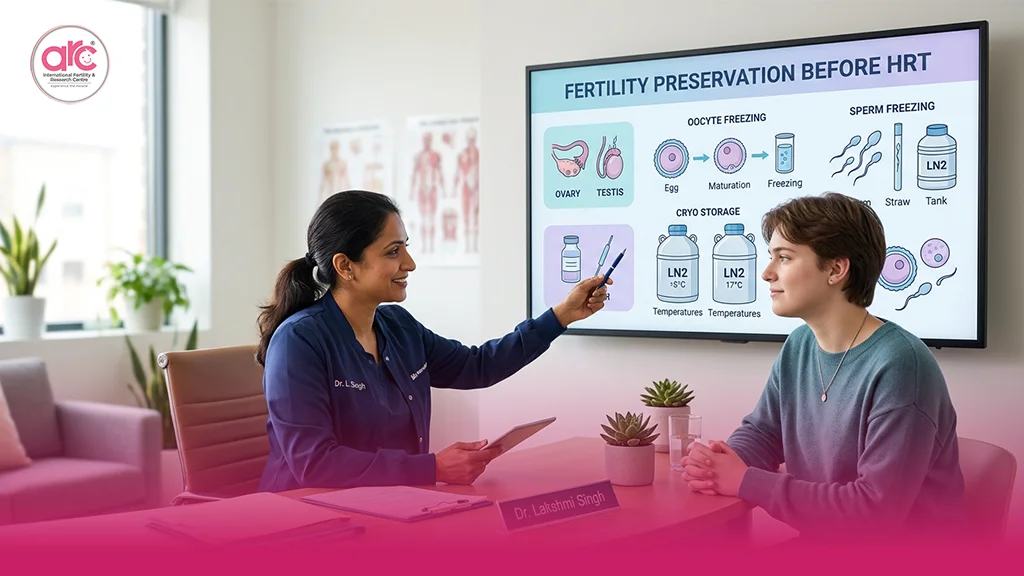
Options for fertility preservation before gender-affirming hormone therapy or surgery in transwomen include cryopreservation of semen or testicular tissue.
For transgender men, individuals assigned female at birth who are transitioning, testosterone therapy suppresses menstruation and ovulation. Testosterone causes the body to stop maturing and ovulating eggs and the goal of egg freezing is to mature and retrieve many eggs.
In both cases, the window for preserving fertility with the greatest ease and the highest success rates is before HRT begins.
Gender-affirming hormones may compromise gonadal function leading to subfertility or infertility. Fertility preservation, egg and sperm freezing, before starting hormones offers future options to transgender individuals.
Sperm Freezing for Transgender Women: What the Process Looks Like?
For transgender women who have not yet started HRT, sperm freezing is straightforward, non-invasive and does not require hormonal stimulation.
In most cases, sperm is collected either at home or at a clinic through masturbation. Less commonly, surgery is required to retrieve the sperm. Cryopreservation preserves and stores sperm for an indefinite amount of time. This allows a transgender woman a chance to have biological children for years to come, using her sperm to fertilise her partner’s egg or a donated egg.
In total, “154 transgender and non-binary patients have been referred to a formalised fertility preservation programme since 2016 and 94.7% completed sperm cryopreservation”, demonstrating that when the conversation happens early, most patients follow through.
What if HRT has already begun? Recovery is possible in some cases, but it is not guaranteed.
In one study, a 26-year-old trans patient’s sperm production returned six months after stopping estradiol and spironolactone treatment that lasted three years. However, another patient showed no signs of spermatogenesis recovery after pausing the same treatment, estrogen and spironolactone, that they had been taking for five years.
The variability in recovery makes pre-HRT preservation the more reliable and lower-risk path. That is why preserving fertility before treatment works better for many patients.
Egg Freezing for Transgender Men: What the Process Involves?
For transgender men who wish to preserve their eggs before starting testosterone therapy, the process is similar to egg freezing for cisgender women, with some additional considerations around gender dysphoria and emotional comfort.
After receiving hormones for 10-12 days, the eggs are collected via a brief surgical procedure and then frozen and stored through cryopreservation. The thawed eggs can later be fertilised with sperm using in vitro fertilisation.
The hormonal stimulation required to produce multiple eggs increases estrogen levels temporarily, which can be challenging for some transgender men. This is an honest reality that ARC discusses openly with every patient, alongside practical ways to navigate the experience with as much comfort as possible.
Ideally, egg freezing would happen before a transman starts HRT, but in reality, it does not always happen that way. A 2020 study of egg freezing outcomes suggests that transmen can still have successful fertility preservation treatment, even if they have been on testosterone prior to treatment. Transgender men taking testosterone will need to stop hormone therapy and resume their menstrual period before freezing their eggs.
For those who have a partner or access to donor sperm, embryo freezing is also an option. Statistics show embryos have higher success rates than frozen eggs alone, but this option requires making decisions about a sperm source upfront.
For a complete breakdown of how embryo cryopreservation works, including the process, benefits and success rates, our guide on embryo cryopreservation: process, benefits and success rates covers every stage in detail.
Transgender Fertility: Freezing Eggs or Sperm Before HRT – Why Timing Changes Everything?
The most important message in this blog is also the simplest one.
Reproductive considerations are often a central part of someone’s medical transition journey. Whether you are interested in having biological children or are just considering your options, fertility preservation options are particularly relevant for individuals who are interested in or undergoing gender-affirming hormone replacement therapy or bottom surgery.
The earlier the conversation happens, ideally before any HRT or surgical intervention, the more options are available, the simpler the process and the better the outcomes.
Waiting until after HRT has begun does not eliminate all options. But it adds complexity, reduces certainty and in some cases closes doors that were open before.
The World Professional Association for Transgender Health and The Endocrine Society both recommend that all transgender patients be counselled on options for fertility preservation prior to transition. The American Society of Reproductive Medicine also put out a statement that providers should offer fertility preservation counselling to individuals before gender transition.
These are not niche recommendations from small organisations. They are the consensus position of the major global bodies in transgender health and reproductive medicine.
The Emotional Dimension: What ARC Understands?
Fertility preservation during gender transition is not purely a clinical decision.
It sits at the intersection of identity, future planning and deeply personal values. Some transgender individuals feel certain they do not want biological children. Others are unsure. Others want to keep every option open without committing to any one path.
All of these positions are valid.
What ARC offers is information – clear, compassionate and non-directive. The decision to preserve fertility is entirely yours. The role of our team is to make sure you have the complete picture before the window closes, not to tell you what to want, but to make sure you know what is possible.
The experience of egg freezing as a form of reproductive autonomy, preserving options on your own timeline, is one that resonates beyond the transgender community. Our guide on why career women freeze eggs explores that same principle from a different angle and the underlying logic of preserving biological options before circumstances change is the same.
What the ARC Evaluation Looks Like?
At a dedicated fertility hospital in Chennai, the transgender fertility preservation consultation at ARC begins with a private, respectful conversation about your transition timeline, your current hormonal status, your family goals and what the realistic options look like for your specific situation.
From there, the evaluation is tailored to you.
For Sperm Freezing: Semen analysis, hormonal assessment and collection at a time that works for you before HRT begins where possible.
For Egg Freezing: Ovarian reserve assessment including AMH and antral follicle count, a discussion of the stimulation protocol and emotional support through a process that may bring its own psychological complexity.
No assumptions and no judgment. Just accurate, individualised clinical information and care.
At the best fertility hospital in Chennai, ARC approaches transgender fertility with the same clinical excellence and human sensitivity it brings to every fertility journey, because the desire to have biological children someday and the right to make that choice freely, belongs to everyone.
Final Thoughts
Your transition is yours!
So is your future.
Preserving your fertility before HRT simply means making sure that future stays as open as you want it to be.
Frequently Asked Questions (FAQs)
Q1. When is the best time for a transgender person to freeze eggs or sperm?
Before starting hormone replacement therapy, when fertility potential is at its highest and the process is simplest. Early counselling ensures no options are lost before a decision is made.
Q2. Can transgender women freeze sperm after starting estrogen therapy?
Possibly, but recovery of sperm production after stopping estrogen is not guaranteed and varies significantly between individuals. Pre-HRT sperm freezing is the more reliable and lower-risk option.
Q3. Does egg freezing for transgender men require stopping testosterone therapy?
Yes, transgender men who are already on testosterone will need to pause hormone therapy and allow their menstrual cycle to resume before egg retrieval can take place. The pause is temporary.
Q4. Are frozen eggs and sperm viable for a long time?
Yes, cryopreserved eggs and sperm can be stored indefinitely without significant degradation in quality. Frozen sperm has roughly equivalent success rates to fresh sperm when used in fertility treatment.
Q5. Is embryo freezing an option for transgender individuals?
Yes, for those with a partner or access to donor gametes, embryo freezing offers higher success rates than egg freezing alone. It requires deciding on a sperm or egg source at the time of preservation.