For many couples undergoing IVF, one of the most reassuring moments is hearing that they have healthy embryos available for freezing. It often means they have additional opportunities for pregnancy without having to repeat the entire IVF process from the beginning.
Embryo cryopreservation, commonly known as embryo freezing, has become an important part of modern fertility treatment. Whether you are planning your first IVF cycle, considering fertility preservation, or thinking about future family planning, understanding how embryo freezing works can help you make informed decisions.
At ARC Fertility Hospitals, a trusted fertility hospital in Chennai, embryo cryopreservation is frequently used to improve treatment flexibility and support long-term reproductive goals for patients.
What Is Embryo Cryopreservation?
Embryo cryopreservation is the process of freezing and storing embryos created through IVF for future use.
After eggs are collected and fertilized with sperm in the laboratory, the resulting embryos are monitored carefully as they develop. Depending on the treatment plan, one embryo may be transferred while additional healthy embryos can be frozen and stored for future pregnancy attempts.
The embryos are preserved at extremely low temperatures using liquid nitrogen, which effectively pauses all biological activity while maintaining their viability.
Today, embryo freezing is considered a routine and highly successful component of assisted reproductive technology.
Why Are Embryos Frozen?
There are several reasons why fertility specialists may recommend embryo freezing.
Multiple Healthy Embryos
During IVF, some patients produce several high-quality embryos. Rather than transferring all embryos at once, doctors often recommend freezing the remaining embryos for future use.
Fertility Preservation
Embryo freezing can be an important option for individuals facing medical treatments such as chemotherapy, radiation therapy, or surgeries that may affect fertility.
Family Planning Flexibility
Some couples wish to preserve embryos for future pregnancies, allowing them to expand their family later without undergoing another complete IVF cycle.
Improving IVF Outcomes
In certain situations, fertility specialists may recommend delaying embryo transfer until the uterine lining is better prepared. This approach, commonly called a freeze-all cycle, allows embryos to be transferred at a later stage when conditions may be more favorable for implantation.
How Does the Embryo Freezing Process Work?
Understanding the embryo freezing process can make fertility treatment feel less overwhelming.
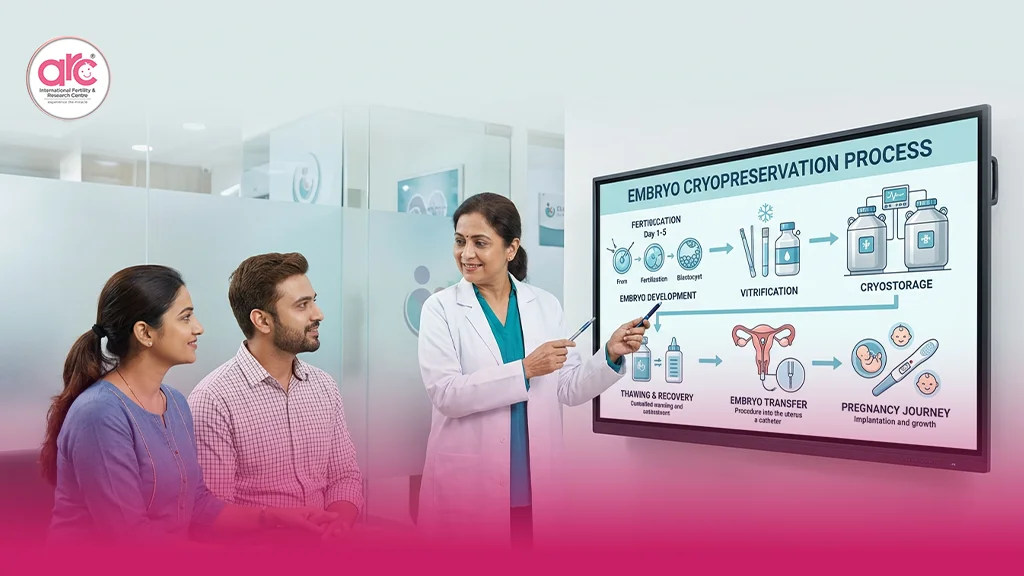
Step 1: Ovarian Stimulation
The IVF journey begins with fertility medications that encourage multiple eggs to mature within the ovaries.
Step 2: Egg Retrieval
Once the eggs are ready, they are collected through a minimally invasive procedure known as egg retrieval.
Step 3: Fertilisation
The collected eggs are fertilized with sperm in the laboratory using either conventional IVF or intracytoplasmic sperm injection (ICSI).
Step 4: Embryo Development
The embryos are monitored closely for several days. Most fertility centers assess embryos until Day 3 or Day 5, known as the blastocyst stage.
Step 5: Embryo Selection
Embryologists evaluate embryo quality based on growth and developmental characteristics. The healthiest embryos are selected for freezing.
Step 6: Vitrification
Modern fertility centers use a rapid-freezing method called vitrification.
Unlike older freezing techniques, vitrification prevents the formation of ice crystals that could damage embryo cells. This method has significantly improved embryo survival rates after thawing.
Step 7: Long-Term Storage
The frozen embryos are stored in specialized cryogenic tanks containing liquid nitrogen at approximately -196°C until they are needed for future treatment.
How Long Can Frozen Embryos Be Stored?
One of the most common questions patients ask is how long frozen embryos remain viable.
Current evidence suggests that embryos can remain safely frozen for many years without significant loss of quality when stored under proper laboratory conditions.
Successful pregnancies have been reported from embryos stored for extended periods, providing couples with greater flexibility in their family-building plans.
What Are the Benefits of Embryo Cryopreservation?
Additional Pregnancy Opportunities
Frozen embryos provide additional chances for pregnancy without repeating ovarian stimulation and egg retrieval.
Reduced Physical and Emotional Burden
Since embryos are already available, future treatment cycles may be simpler and less physically demanding.
Cost Efficiency
Using frozen embryos can often be more cost-effective than undergoing a completely new IVF cycle.
Better Treatment Timing
Embryo freezing allows fertility specialists to transfer embryos when the uterine environment is most favorable for implantation.
Fertility Preservation
Embryo cryopreservation provides an opportunity to preserve reproductive potential for future use.
Does Embryo Freezing Affect Success Rates?
This is one of the most important concerns for patients.
With modern vitrification techniques, embryo survival rates after thawing are very high. In many fertility centers, frozen embryo transfer (FET) outcomes are comparable to, and in some cases even better than, fresh embryo transfer outcomes.
However, success rates depend on several factors, including:
- Maternal age
- Embryo quality
- Uterine health
- Hormonal balance
- Sperm quality
- Underlying fertility conditions
Embryo freezing itself does not guarantee pregnancy, but it significantly increases future treatment opportunities.
What Happens During Frozen Embryo Transfer?
When a patient decides to use frozen embryos, the embryos are carefully thawed and assessed before transfer.
The uterine lining is prepared either naturally or with hormonal support. Once the lining reaches the desired thickness, the embryo is transferred into the uterus through a simple procedure called Frozen Embryo Transfer (FET).
Unlike egg retrieval, embryo transfer is usually quick, minimally invasive, and does not require anesthesia.
Is Embryo Cryopreservation Safe?
Embryo freezing has been used successfully for decades and is considered safe when performed in experienced fertility centers.
Research has shown that children born from frozen embryos generally have similar health outcomes to those born from fresh embryo transfers.
This is why embryo cryopreservation has become a standard component of IVF treatment worldwide.
When Should You Consider Embryo Freezing?
You may want to discuss embryo cryopreservation with a fertility specialist if:
- You are undergoing IVF treatment
- You have multiple healthy embryos available
- You wish to preserve fertility before medical treatment
- You plan to delay pregnancy
- You want flexibility for future family planning
A consultation with the best fertility hospital in Chennai can help determine whether embryo freezing aligns with your reproductive goals and treatment plan.
Final Thoughts
Embryo cryopreservation has transformed fertility treatment by giving patients more flexibility, more opportunities for pregnancy, and greater control over future family planning. Modern vitrification techniques have made embryo freezing safer and more effective than ever before.
At ARC Fertility Hospitals, every embryo freezing decision is guided by personalized care, advanced laboratory standards, and evidence-based fertility practices. Whether you are beginning IVF, considering fertility preservation, or planning for future pregnancies, understanding embryo cryopreservation can help you approach your fertility journey with greater confidence and clarity.