
Overview
She had been researching donor egg IVF for three months.
AMH at 0.3, three failed stimulation cycles, her own eggs were simply not producing the response needed.
The specialist at ARC had explained the next step clearly. Donor egg IVF, where a carefully screened donor’s eggs are used instead of her own, offered significantly higher success rates for her specific situation.
But alongside the clinical questions came the legal ones.
Who can donate? What information do I get? What are my rights? What are the child’s rights?
These are exactly the questions the “New ART Act Regulations for Donor Egg IVF treatments” are designed to answer and understanding them is an important part of navigating this pathway with clarity and confidence.
What the ART Act Actually Is And Why It Changed Everything?
India’s Assisted Reproductive Technology (Regulation) Act, 2021, came into effect in January 2023 and was followed by the ART Rules 2022 and subsequent 2024 amendments. Together, these form the most comprehensive legal framework India has ever had for fertility treatment, including donor egg IVF.
The regulation of Assisted Reproductive Technology services shall be governed by the ART Rules 2024. These rules create ART and surrogacy boards at national and state levels, require maintenance of a registry of ART clinics and banks and aim at safeguarding the rights of patients, particularly women, alongside health and safety standards for ART practice.
Before this legislation, India’s fertility industry operated under informal ICMR guidelines. Now, every registered clinic, including ARC, operates under a legally binding framework that protects patients, donors and children born through ART in ways that were not previously enforceable.
Who Can Donate Eggs Under the New ART Act?
This is the most clinically significant change for patients seeking donor egg IVF and one that directly affects donor availability across India.
A bank can obtain eggs from females between 23 and 35 years of age. An egg donor should be an ever-married woman having at least one alive child of her own, minimum 3 years of age. The woman can donate eggs only once in her life and not more than 7 eggs can be retrieved from her. A bank cannot supply gametes of a single donor to more than one commissioning party.
Breaking this down practically:
- Age requirement: 23 to 35 years only
- Marital status: Must be married
- Prior parenthood: Must have at least one living child aged 3 or older
- Lifetime limit: One donation, across all clinics and banks in India
- Egg cap: Not more than 7 eggs retrieved per donation
- Exclusivity: One donor’s eggs go to one recipient only. No sharing between commissioning parties
These requirements were introduced to protect donors from repeated hormonal stimulation risk and from being exploited commercially. The trade-off is that the donor pool is significantly more restricted than before, which is why registered ART banks like ARC maintain rigorously screened donor lists.
What Information Recipient Couples Receive About the Donor?
The ART Act enforces strict donor anonymity but not total information blackout.
The law mandates strict anonymity. You cannot meet the donor, see photographs or receive any identifying information. The ART Bank will provide you with a detailed profile of non-identifying characteristics, including physical characteristics such as height, weight, eye colour, hair colour and skin tone. This allows you to make an informed choice and find a donor who shares characteristics you desire, while legally protecting the privacy of all parties.
Donors are also screened for genetic diseases before any donation proceeds. Genetic disease screening is required prior to embryo transfer, a mandatory safeguard that protects both the recipient and any child born from the donation.
New ART Act Regulations For Donor Egg IVF Treatments: Your Legal Rights as a Patient
New ART Act regulations for donor egg IVF treatments give commissioning patients clearly defined legal protections that were not previously codified.
Your rights under the ART Act include:
- Written consent is mandatory: No ART procedure can be carried out without the written informed consent of both the commissioning parties and the donor. You cannot be rushed or pressured into any treatment decision.
- Insurance must be provided for the donor: The commissioning couple or individual must provide 12 months of insurance coverage in favour of the oocyte donor. This protects the donor and by extension, ensures that donors are participating willingly and with full awareness of the process.
- Privacy is legally protected: Your identity and all details of your treatment are strictly confidential. The clinic cannot disclose this information to anyone without your explicit consent, except to the National Registry as required by law, which also maintains confidentiality.
- The child’s legal status is clearly defined: A child born through ART is legally recognised as the biological child of the commissioning couple and is entitled to all the same rights and privileges as a naturally conceived child. The donor has no parental rights whatsoever over the resulting child.
Who Is Eligible to Use Donor Egg IVF Under the ART Act?
The ART Act is inclusive in its eligibility framework, more so than many patients realise.
Single women over the age of 21 who are Indian citizens are explicitly permitted to undergo ART procedures, including donor egg IVF. The same rules regarding donor screening, informed consent and the rights of the child apply equally.
The age limit for a woman to undergo ART procedures is 50 years. Women above this age are not eligible to commence a new IVF cycle using either their own eggs or donor eggs.
For couples where the female partner is over 50 or where medical assessment indicates that carrying a pregnancy is inadvisable, a discussion about alternative paths to parenthood is part of the consultation ARC offers.
What Donor Egg IVF Looks Like at ARC, Within the ART Framework?
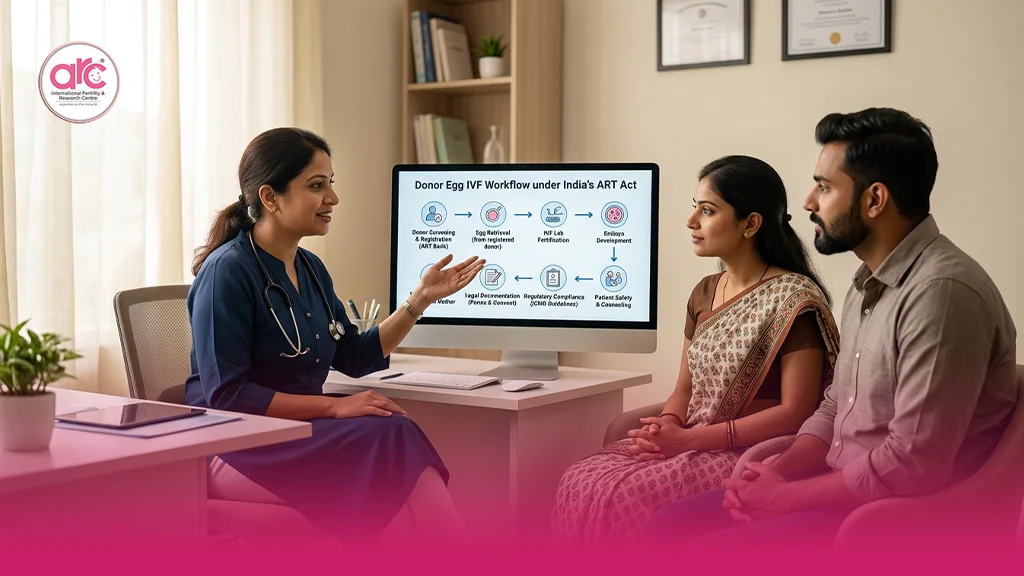
At ARC, donor egg IVF operates fully within the ART Act framework – registered, compliant and transparent.
The process for a recipient involves ovarian suppression and uterine preparation to synchronise the lining with the donor’s cycle. Once the donor’s eggs are retrieved, fertilised with the partner’s or donor sperm and developed to blastocyst stage, the strongest embryo is selected for transfer.
The precision of that embryo selection has improved significantly with technology. Our guide on how AI is changing IVF embryo selection covers how advanced imaging and algorithm-driven selection at ARC is improving the odds of a successful transfer from each cycle.
For women who are considering donor egg IVF because of diminished ovarian reserve, it is also worth understanding whether regenerative approaches might be explored before moving to donation. Our guide on ovarian PRP and whether it can reverse fertility aging covers the evidence on this emerging approach and helps clarify which patients are the right candidates for PRP versus those for whom donor egg IVF is the more appropriate next step.
According to the Ministry of Health and Family Welfare’s ART Act FAQ, ART clinics are legally required to maintain records of all donations for at least 10 years, after which records must be transferred to the National Registry, ensuring long-term accountability for every donation that occurs under the Act.
Why ART Compliance Matters When Choosing Your Clinic?
The ART Act carries real penalties for non-compliance.
Offences include gamete or embryo sale or trade, sexual selection, exploitation of donors or couples. Penalties range from 5 to 10 lakh rupees for a first offence, with repeat offenders facing 3 to 8 years imprisonment and fines of 10 to 25 lakh rupees.
This means the clinic you choose for donor egg IVF matters, not just clinically, but legally. Choosing a registered, compliant clinic protects you, the donor and any child born from the treatment.
At a dedicated fertility hospital in Chennai, ARC operates as a fully registered ART clinic and bank, compliant with the ART Act 2021, ART Rules 2022 and all subsequent 2024 amendments. Every donor egg IVF cycle at ARC is conducted within the legal framework, with mandatory consent, insurance, genetic screening and anonymity protocols fully in place.
At the best fertility hospital in Chennai, ARC’s approach to donor egg IVF combines clinical excellence with full legal compliance, so every patient knows exactly what the law gives them, what it protects and what the process will look like from consultation to transfer.
Final Thoughts
She left the consultation knowing more than she had walked in with.
Not just about the clinical process. But about her rights, donor’s protections and what the law says her child will legally be, without question or ambiguity.
That clarity did not make the decision easier.
But it made the path forward cleaner.
Frequently Asked Questions (FAQs)
Q1. Can a relative donate eggs for IVF under the ART Act?
No! The ART Act requires donors to be anonymous and sourced through registered ART banks. Close relatives such as sisters or cousins cannot legally donate eggs for IVF under the current framework.
Q2. How many times can a woman donate eggs under the ART Act?
Only once in her lifetime, across all clinics and banks in India. The single-lifetime donation limit was introduced to protect donors from repeated stimulation risk and prevent exploitation.
Q3. Will my child have legal rights equal to a naturally conceived child?
Yes, a child born through donor egg IVF is legally recognised as the biological child of the commissioning couple and has all the same rights and privileges as a child born naturally, including inheritance rights.
Q4. Can single women use donor egg IVF in India?
Yes, single women over 21 who are Indian citizens are explicitly permitted to access donor egg IVF under the ART Act, using donor sperm alongside donor eggs with the same legal protections that apply to couples.
Q5. What genetic testing is required before donor egg IVF?
Under the ART Act, genetic disease screening is mandatory before embryo transfer. At ARC, donors undergo comprehensive medical and genetic screening as part of the registration and approval process before their eggs are made available to any commissioning party.


