Overview
You’ve always believed in movement.
Lifting made you feel strong. Structured workouts gave you control. Exercise was the one place your body listened to you without question.
Then IVF entered the picture.
Suddenly, the gym feels risky. Your ovaries feel heavy. Every squat, every deadlift, every core movement comes with a new question.
Am I helping my body, or hurting this cycle?
This anxiety is common, especially among fitness-conscious women who are used to pushing through discomfort. IVF changes the rules, not because your body becomes weak, but because it becomes temporarily vulnerable in very specific ways.
Why IVF Changes How the Body Responds to Exercise
During ovarian stimulation, your ovaries do not behave like they normally do.
They enlarge. They become heavier. They are more mobile inside the abdomen.
This isn’t subtle. In some women, ovaries can increase several times their usual size. That physical change alone alters what is safe.
At a fertility hospital in Chennai, doctors do not discourage exercise because movement is bad. They caution against certain movements because anatomy has changed.
The issue is not effort. It is mechanics.
Understanding the Real Medical Risk: Ovarian Torsion
The biggest concern with intense exercise during stimulation is ovarian torsion.
Torsion happens when an enlarged ovary twists around its blood supply. It causes sudden, severe pain and is a surgical emergency.
Movements that increase this risk include heavy lifting, jumping, sprinting, and rapid twisting of the torso.
Weightlifting becomes risky not because it builds muscle, but because it increases intra-abdominal pressure and often involves bracing, breath-holding, and forceful core engagement.
These actions can destabilise enlarged ovaries.
This is why most clinics recommend avoiding lifting anything heavier than 10 to 15 kilograms during stimulation.
Why “If It Feels Fine” Is Not a Reliable Guide
Many women say they feel fine at the gym, even late into stimulation.
That doesn’t mean the risk isn’t there.
Ovarian torsion is not about pain building slowly. It can happen suddenly, without warning, after movements the body tolerated the day before.
The best fertility hospital in Chennai advises caution not because torsion is common, but because when it happens, it is serious enough to jeopardise the cycle.
IVF is already asking your body to do a lot. Avoiding preventable emergencies is part of protecting the process.
The Transfer Window: A Different Kind of Sensitivity
Even after retrieval, exercise choices still matter.
The transfer window is less about torsion and more about blood flow to the uterine lining.
Heavy lifting increases pressure in the abdomen and pelvis. This can temporarily divert blood flow away from the uterus.
The uterine lining relies on steady, gentle circulation to remain receptive. High-intensity strength training can disrupt that balance during a time when precision matters more than power.
This does not mean movement should stop. It means intensity should change.
What “Safe Exercise” Actually Looks Like During IVF
Safe movement during IVF is about support, not performance.
Generally encouraged activities include:
- Walking at a comfortable pace
- Gentle yoga without deep twists or inversions
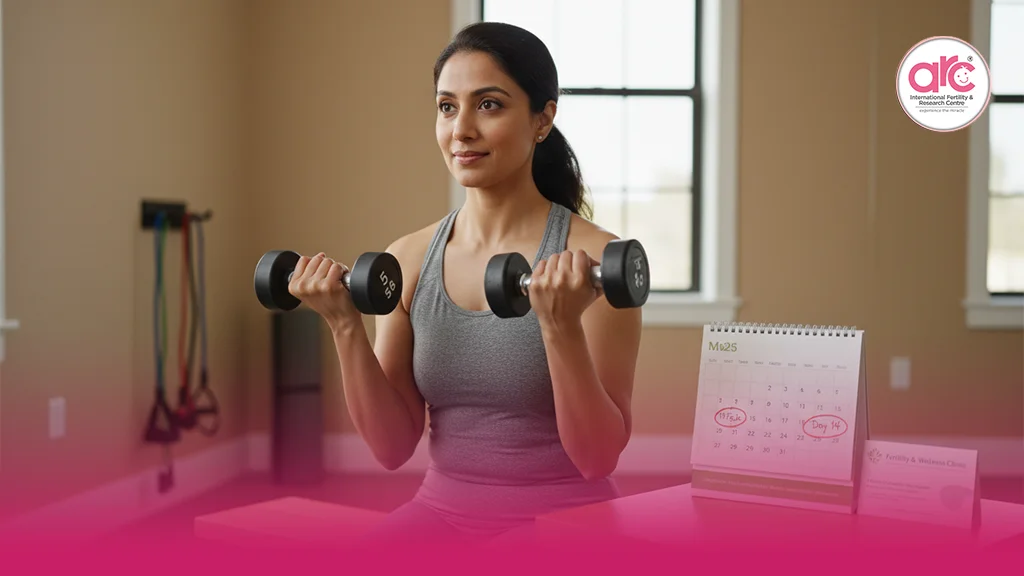
- Light resistance work with low weights and controlled breathing
- Stretching that avoids abdominal strain
These forms of movement improve circulation, reduce inflammation, and regulate stress hormones.
They help the body cooperate with treatment instead of fighting it.
Why Complete Rest Is Not the Answer Either
On the other extreme, some women stop moving entirely.
This often increases stiffness, worsens mood, and heightens anxiety.
Complete rest does not improve implantation. Prolonged inactivity can reduce circulation and make the body feel heavier and more uncomfortable.
The goal is not to freeze your life. It is to modify it temporarily.
IVF does not ask you to give up who you are. It asks you to adapt how you move for a short window of time.
Listening to the Body Without Testing Its Limits
During IVF, the body gives quieter signals.
Pelvic heaviness. Pressure. A feeling of fullness rather than sharp pain.
These sensations are cues, not challenges.
Pushing through them at the gym is not discipline. It is miscommunication.
If a movement makes you brace, strain, or hold your breath, it is likely too much for this phase.
If movement leaves you calmer and looser, it is usually serving you well.
Why This Anxiety Is So Common in Fit Women
Women who train regularly are used to trusting their bodies.
IVF introduces a lack of predictability that feels unsettling. Suddenly, the body isn’t responding to effort in the usual way.
This loss of control often leads to overthinking every choice.
Understanding the “why” behind restrictions helps replace fear with clarity.
Exercise is not the enemy. Timing and intensity are the variables.
What About After Transfer?
After embryo transfer, gentle movement is still encouraged.
Short walks and light activity do not dislodge embryos. The uterus is not an open space where embryos can fall out.
What should be avoided are high-impact workouts, heavy lifting, and anything that causes significant strain or fatigue.
Calm movement supports implantation by maintaining circulation without triggering stress responses.
Fitness Is Not a Moral Test During IVF
Taking a break from intense training does not mean you are losing strength.
Strength returns quickly. Cycles do not.
Protecting a few weeks of treatment does not erase years of fitness.
This perspective matters, especially for women who define themselves by consistency and performance.
Your body is still strong. It is simply doing a different kind of work right now.
A Broader View of Lifestyle and Fertility
Exercise is only one piece of the fertility puzzle.
Heat exposure, clothing choices, sleep, stress, and nutrition all play roles, especially for the male partner as well.
Exercise is just one part of the puzzle, see how lifestyle affects the male partner in our post on Boxer Shorts vs. Briefs: Do They Really Affect Sperm?
Fertility works best when both partners adjust together.
A Grounding Truth to Carry With You
Intense exercise does not ruin IVF. Ignoring physiological changes can.
This phase is temporary. The goal is not to stop moving, but to move with awareness.
When you respect what your body is going through, you are not giving up strength. You are applying it wisely.
And wisdom, during IVF, is one of the most powerful forms of strength there is.