For many couples, IVF feels like the next logical step after months or years of trying to conceive. However, one common question during fertility evaluation is whether additional procedures are needed before starting treatment. One such procedure is diagnostic laparoscopy.
If your fertility specialist recommends it, you may wonder: Do I really need a diagnostic laparoscopy before IVF? Will it improve my chances of pregnancy?
The answer depends on your individual fertility history. While diagnostic laparoscopy can identify conditions that routine scans may miss, it is not recommended for every woman planning IVF. Today’s fertility specialists carefully balance the benefits of finding hidden reproductive problems against the fact that laparoscopy is still a surgical procedure.
At ARC Fertility Hospitals, the focus is on recommending investigations that genuinely influence treatment decisions. Rather than performing surgery routinely, fertility specialists evaluate whether laparoscopy is likely to change the treatment plan or improve the chances of a successful pregnancy.
What Is Diagnostic Laparoscopy?
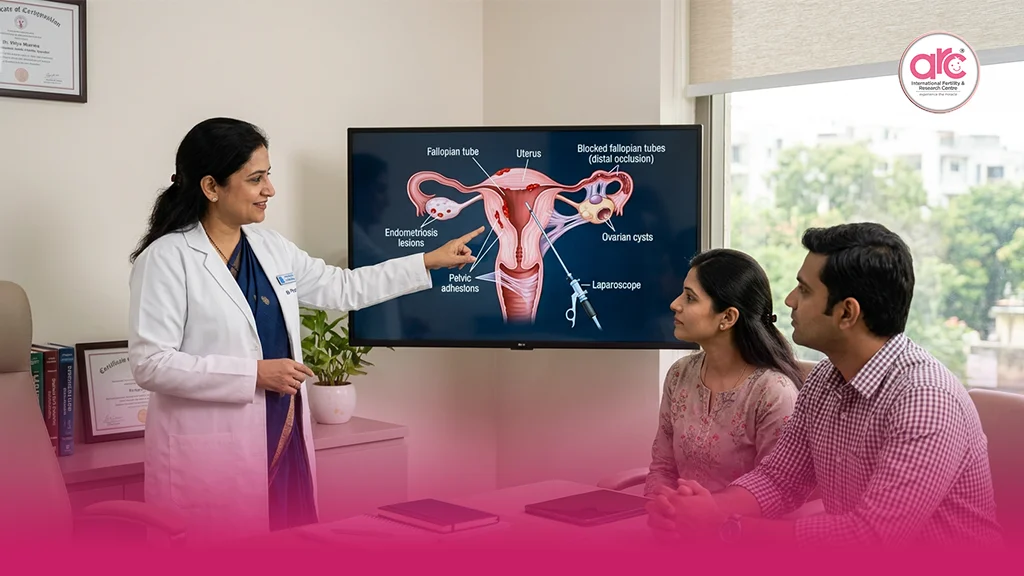
Diagnostic laparoscopy is a minimally invasive surgical procedure that allows doctors to examine the reproductive organs directly. Through one or two small incisions near the navel, a thin camera called a laparoscope is inserted into the abdomen, providing a clear view of the uterus, ovaries, fallopian tubes, and surrounding pelvic structures.
Unlike an ultrasound or X-ray, laparoscopy allows doctors to identify subtle abnormalities that may not appear on imaging tests.
During the same procedure, minor conditions such as adhesions, ovarian cysts, or mild endometriosis may sometimes be treated if appropriate.
Why Is Diagnostic Laparoscopy Sometimes Recommended Before IVF?
Most women do not need laparoscopy before IVF. In many cases, fertility specialists can make treatment decisions based on ultrasound scans, hormone tests, semen analysis, and tubal assessment.
However, laparoscopy may be recommended when there is suspicion of conditions that could affect fertility or IVF outcomes but cannot be confirmed through routine investigations.
Your doctor may suggest laparoscopy if you have:
- Persistent pelvic pain
- Suspected endometriosis
- Previous pelvic infections or Pelvic Inflammatory Disease (PID)
- A history of ectopic pregnancy
- Prior abdominal or pelvic surgery
- Unexplained infertility despite normal routine tests
- Suspected pelvic adhesions
- Hydrosalpinx (fluid-filled fallopian tube)
The goal is not simply to diagnose a condition but to determine whether treating it could improve fertility or IVF success.
Conditions Diagnostic Laparoscopy Can Detect
Endometriosis
Mild or moderate endometriosis is sometimes difficult to diagnose with ultrasound alone.
Laparoscopy remains one of the most accurate ways to confirm endometriosis, assess its severity, and remove visible lesions when appropriate. Treating significant endometriosis may improve fertility planning in selected women.
Pelvic Adhesions
Scar tissue from previous infections, surgeries, or endometriosis can pull reproductive organs out of their normal position. Adhesions may affect egg pickup by the fallopian tubes or contribute to chronic pelvic pain.
Laparoscopy allows doctors to identify and, in many cases, remove these adhesions.
Blocked or Damaged Fallopian Tubes
Although an HSG test provides useful information, laparoscopy offers a direct view of the fallopian tubes and surrounding tissues.
If hydrosalpinx is present, fertility specialists may recommend treating or removing the affected tube before IVF because the accumulated fluid may reduce implantation rates.
Ovarian Cysts
Certain ovarian cysts, particularly endometriomas, may require further assessment before IVF.
Laparoscopy helps determine whether treatment is necessary while balancing the need to preserve ovarian reserve.
Does Every Woman Need Diagnostic Laparoscopy Before IVF?
No.
Current fertility guidelines do not recommend routine laparoscopy before IVF for every patient.
This approach is also supported by clinical recommendations from the American Society for Reproductive Medicine (ASRM), which advises that laparoscopy should be performed only when there is a clear clinical indication rather than as a routine test before IVF.
If ultrasound findings are normal, the tubes have already been assessed, and there are no symptoms suggesting pelvic disease, many women can proceed directly to IVF without surgery.
Avoiding unnecessary procedures helps reduce cost, recovery time, and surgical risks.
Can Diagnostic Laparoscopy Improve IVF Success?
The answer depends on why the laparoscopy is being performed.
The procedure itself does not increase IVF success.
However, treating conditions discovered during laparoscopy—such as hydrosalpinx, severe endometriosis, or dense pelvic adhesions—may improve the environment for embryo implantation in carefully selected patients.
Your fertility specialist will recommend laparoscopy only if the expected benefit outweighs the risks.
What Happens During the Procedure?
Diagnostic laparoscopy is performed under general anaesthesia.
The surgeon makes a small incision near the belly button and gently inflates the abdomen with carbon dioxide gas to improve visibility.
A laparoscope is inserted, allowing the reproductive organs to be examined carefully.
If minor abnormalities are found and prior consent has been obtained, they may be treated during the same procedure.
Most laparoscopies take between 30 minutes and one hour, depending on the findings.
Recovery After Diagnostic Laparoscopy
Most women return home the same day or after an overnight stay.
Common temporary symptoms include:
- Mild abdominal discomfort
- Shoulder pain caused by the gas used during surgery
- Bloating
- Tiredness
- Mild spotting
Many women resume light daily activities within a few days, while complete recovery usually takes one to two weeks.
Your doctor will advise when it is safe to exercise, have intercourse, or begin fertility treatment.
Are There Any Risks?
Like any surgical procedure, diagnostic laparoscopy carries some risks, although serious complications are uncommon.
Possible risks include:
- Infection
- Bleeding
- Injury to nearby organs such as the bowel or bladder
- Anaesthesia-related complications
- Rare blood vessel injury
These complications are uncommon when the procedure is performed by experienced surgeons.
What Is the Cost of Diagnostic Laparoscopy?
The cost varies depending on several factors, including:
- Hospital facilities
- Surgeon’s experience
- Anaesthesia charges
- Diagnostic versus operative laparoscopy
- Additional procedures performed during surgery
- Insurance coverage
If laparoscopy identifies and treats a condition that could otherwise reduce IVF success, it may help avoid repeated unsuccessful treatment cycles. Discuss the expected costs and benefits with your fertility specialist before making a decision.
When Should You Consider Laparoscopy Before IVF?
Your doctor may recommend laparoscopy if:
- You have chronic pelvic pain
- Endometriosis is strongly suspected
- Previous fertility tests are inconclusive
- Hydrosalpinx has been detected
- You have repeated IVF implantation failure with suspected pelvic pathology
- You have a history of pelvic infection or abdominal surgery
The decision should always be individualised rather than based on routine practice.
Many couples searching for the Best Fertility Hospital in Chennai appreciate centres that recommend surgery only when there is clear medical value rather than making it a standard step before IVF.
Choosing the Right Fertility Centre
Diagnostic laparoscopy is only one part of a comprehensive fertility evaluation.
At ARC Fertility Hospitals, specialists carefully review your medical history, ultrasound findings, hormone profile, ovarian reserve, semen analysis, and previous treatment history before deciding whether laparoscopy is necessary.
If you are looking for a Fertility Hospital in Chennai, choose a team that explains the reason behind every investigation, discusses alternative approaches, and creates a personalised treatment plan based on your unique fertility needs.
Final Thoughts
Diagnostic laparoscopy can provide valuable information that routine fertility tests sometimes miss. It is particularly useful for diagnosing endometriosis, pelvic adhesions, hydrosalpinx, and other conditions that may influence fertility treatment decisions.
However, not every woman needs laparoscopy before IVF. For many couples, IVF can begin safely without surgery. The decision should depend on your symptoms, fertility history, previous test results, and the likelihood that laparoscopy will change your treatment plan.
If your doctor recommends diagnostic laparoscopy, ask why it is being suggested, what information it is expected to provide, and whether it is likely to improve your chances of pregnancy. A personalised, evidence-based approach helps ensure that every investigation supports your journey toward parenthood rather than adding unnecessary procedures.