Overview
There is a version of this conversation that happens quietly, usually somewhere between the sixth and twelfth month of trying.
You have been doing everything right. Tracking cycles, timing things carefully and staying hopeful. And yet, nothing has happened. And somewhere in that silence, a question starts forming, “Should I get tested?”
It is a reasonable question. And for a lot of women, it comes loaded with anxiety about what the answer might reveal. What is worth knowing before the anxiety takes over is this. According to the World Health Organization, roughly 1 in 6 people worldwide experience infertility in their lifetime. (Source: WHO, April 2023)
Fertility tests are not about passing or failing; it’s about getting more information to guide your next steps. And the sooner you have it, the more options you have.
When should you actually get tested?
This is where a lot of unnecessary waiting happens. Because the general advice of “try for a year before seeing a doctor” does not apply to everyone equally.
The actual guidance, based on clinical evidence, looks more like this:
• Under 35 years old: If you have been trying to conceive for 12 months without success, that is a reasonable point to seek evaluation.
• Over 35: The window shortens significantly. Six months of trying without conception is enough reason to get tested. Egg quantity and quality decline with age, and earlier evaluation simply gives you more to work with.
• Any age: If you have irregular or absent periods, a known condition like PCOS or endometriosis, a history of pelvic infections, two or more miscarriages, or have undergone cancer treatment in the past, do not wait. Get evaluated sooner.
Waiting is not always the patient thing to do. Sometimes it is just a delayed thing to do.
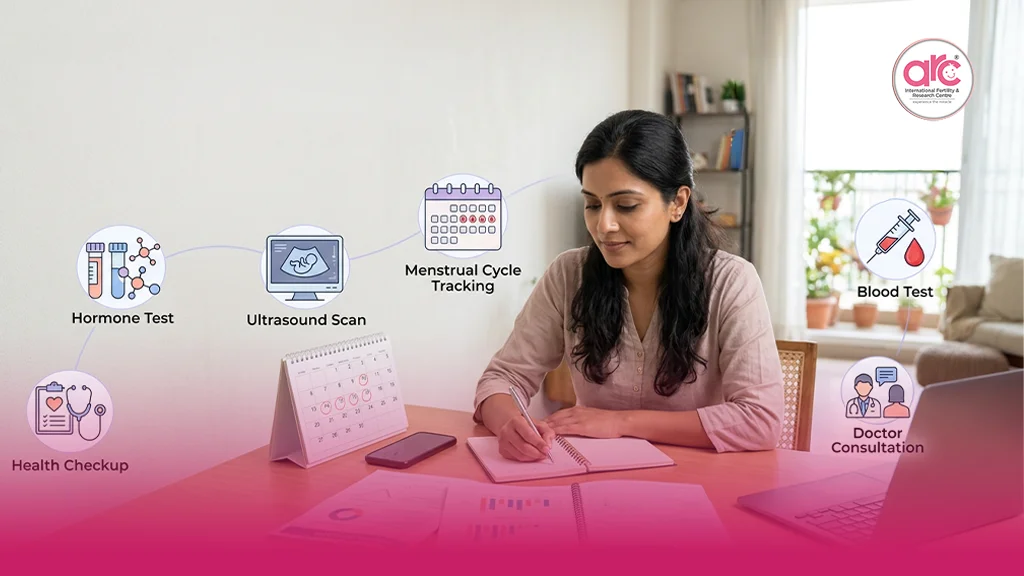
What fertility tests for women actually involve?
This is where a lot of the anxiety lives: the fear of what the tests will be like, how invasive they are and what they might find.
Let us walk through each one in a simple, understandable language
i) Blood tests for hormonal assessment
This is usually where evaluation begins. A simple blood draw, typically done on specific days of your menstrual cycle, can reveal a significant amount about how your reproductive system is functioning.
Key hormones tested include FSH (follicle-stimulating hormone), LH (luteinizing hormone), oestrogen, prolactin and thyroid hormones. Abnormal levels in any of these can point to ovulation issues, thyroid dysfunction or pituitary problems, all of which are treatable once identified.
If you want to understand how specific hormones like oestrogen and progesterone actually influence your ability to conceive, and why inflammation matters more than most people realise, this is worth reading before your consultation.
ii) AMH: Anti-Müllerian Hormone
AMH has become one of the most important markers in fertility evaluation. It reflects your ovarian reserve, essentially how many eggs remain available. Unlike most hormone tests, AMH can be tested on any day of your cycle, making it convenient and reliable.
A lower AMH does not mean you cannot conceive. But it does shape the conversation about timing and treatment approach. Knowing early gives you options.
iii) Antral Follicle Count (AFC) via Ultrasound
This is a transvaginal ultrasound, mildly uncomfortable for some, but not painful. This involves counting the number of small follicles visible in the ovaries. It is another window into ovarian reserve and works best when read alongside the AMH result.
The ultrasound also checks the size and structure of the ovaries and uterus, looking for cysts, fibroids or structural concerns that might affect implantation.
iv) Day 21 Progesterone Test
This blood test, taken around day 21 of a 28 day cycle, confirms whether ovulation has actually occurred. Many women assume they are ovulating because their cycles appear regular, but this test provides confirmation rather than assumption.
If progesterone levels are low, it suggests ovulation may not be happening consistently, which is a significant and addressable finding.
v) Hysterosalpingography (HSG)
This is the test that sounds more frightening than it usually is. HSG is an X-ray procedure where a dye is passed through the uterus and fallopian tubes to check whether they are open and structurally normal.
Blocked tubes can prevent sperm from reaching the egg entirely. HSG identifies this clearly, and in some cases, the procedure itself can temporarily improve tube function, which is an interesting added benefit.
What is the experience actually like?
Most fertility investigations are outpatient, meaning you come in, complete the tests and go home. There are no overnight stays and very little recovery time involved.
Blood tests take minutes. The ultrasound takes around 15 to 20 minutes. The HSG involves a short clinic visit with mild cramping for some women, similar to period pain.
What takes more time is the interpretation, understanding what the results mean together, not in isolation.
A single low AMH result, for example, means something different when read alongside AFC, hormone levels and cycle history.
This is why it is worth doing these tests with specialists who take the time to explain the full picture rather than hand you a report and leave you to search the internet.
What happens after the results?
Results from fertility tests do not always mean treatment is immediately necessary. In many cases, they provide reassurance.
In others, they identify something specific that can be addressed, a thyroid imbalance corrected with medication, an ovulation issue treated with simple tablets or a structural concern managed with a minor procedure.
Even when the path forward involves more complex treatment like IUI or IVF, knowing earlier means beginning with better information, more time and a clearer plan.
If your evaluation does point towards IVF as the next step, understanding what additional testing that involves can help you feel prepared before your first appointment. Here is a detailed breakdown of what tests are done before IVF and why each one matters.
The team at our fertility hospital in Chennai approaches every woman’s results as a starting point, not a conclusion. Each finding is discussed in context and the next steps are built around individual circumstances, not a standard protocol applied to everyone.
A note on going together
If you are in a relationship and considering fertility evaluation, it is worth knowing that female fertility testing and male semen analysis are typically recommended together.
Around 40% of fertility challenges involve male factors. Evaluating both partners at the same time prevents delays and gives a more complete picture from the beginning.
The one thing worth saying clearly
Fertility testing is not something you do when hope runs out. It is something you do to protect hope, to understand where you are, what is working and what needs support.
Whether you are 28 and simply curious about your ovarian reserve, 34 and actively trying or 38 and feeling like time is pressing, the information you get from a proper fertility evaluation is never wasted.
At the best fertility hospital in Chennai, the goal of every first consultation is simple: to give you clarity, neither fear nor overwhelming medical jargon.
Just an honest understanding of where your fertility stands and what your genuine options are from here.
“Knowing is always better than wondering. And the right time to find out is always sooner than you think”.