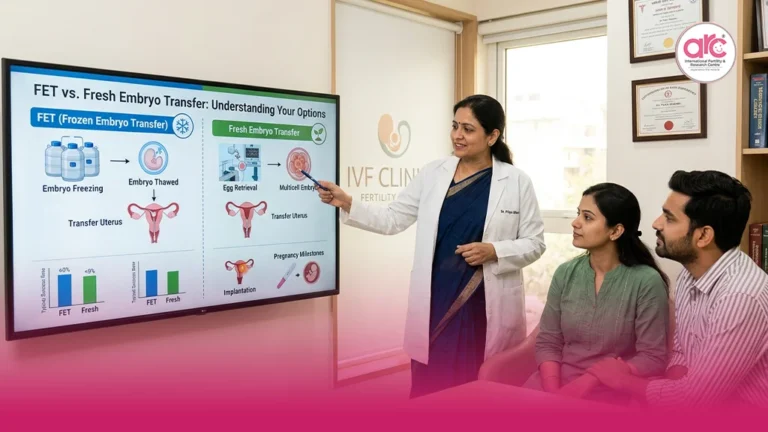
How IVF has evolved over the decades is a story of remarkable medical innovation and hope. Over the past four decades, in vitro fertilization has transformed from an experimental procedure into one of the most successful fertility treatments available today. Millions of couples around the world have achieved parenthood thanks to continuous advances in reproductive medicine, embryology, and personalised fertility care.
Yet, the IVF treatment we know today is very different from the one introduced more than four decades ago. Over the past 42 years, advances in medical science, laboratory technology, embryo culture, genetics, and patient care have dramatically improved success rates while making treatment safer and more personalized.
At ARC Fertility Hospitals, understanding this evolution helps patients appreciate that IVF is no longer an experimental procedure. It is a carefully refined treatment backed by decades of research, innovation, and clinical experience.
The Beginning of IVF: A Medical Milestone
The history of IVF changed forever in 1978, when the world’s first IVF baby, Louise Brown, was born in the United Kingdom. Her birth proved that fertilization outside the human body could result in a healthy pregnancy and childbirth.
In India, another historic milestone came in 1978 with the birth of Kanupriya Agarwal (Durga), one of the country’s first IVF babies, marking the beginning of assisted reproductive technology in India.
These breakthroughs offered hope to couples who had previously been told they would never have biological children.
In the early years, however, IVF was still in its infancy. Success rates were relatively low, medications were less refined, and laboratory conditions were far less advanced than they are today.
How IVF Has Changed Over the Decades
Better Fertility Medications
Early IVF cycles relied on limited ovarian stimulation protocols. Today, fertility medications are far more sophisticated, allowing doctors to stimulate the ovaries more safely while reducing the risk of complications such as ovarian hyperstimulation syndrome (OHSS).
Treatment is now tailored according to:
- Age
- AMH levels
- Antral follicle count
- Body weight
- Previous IVF response
- PCOS or diminished ovarian reserve
This personalised approach improves both safety and treatment outcomes.
Improved Embryology Laboratories
One of the biggest advances in IVF has happened inside the embryology laboratory.
Modern IVF laboratories now use:
- Advanced incubators
- Stable temperature control
- Controlled oxygen environments
- Continuous embryo monitoring
- Strict air-quality management
These improvements create conditions that closely mimic the natural environment inside the human body, supporting healthier embryo development.
The Introduction of Blastocyst Culture
In earlier years, embryos were commonly transferred on Day 2 or Day 3 after fertilisation.
Today, many IVF centres grow embryos until Day 5 or Day 6, when they reach the blastocyst stage.
Blastocyst transfer offers several advantages:
- Better embryo selection
- Higher implantation potential
- Lower chance of transferring embryos unlikely to develop
- Increased pregnancy rates in suitable patients
Not every patient requires blastocyst transfer, but it has become an important advancement in modern IVF practice.
Embryo Freezing Has Improved Dramatically
Years ago, freezing embryos often produced inconsistent results.
Today, the introduction of vitrification, an ultra-rapid freezing technique, has significantly improved embryo survival after thawing.
Modern embryo freezing allows patients to:
- Preserve fertility before cancer treatment
- Delay pregnancy planning
- Store extra embryos from an IVF cycle
- Perform frozen embryo transfer (FET) in later cycles
Frozen embryo transfers now achieve pregnancy rates comparable to, and in many cases even better than, fresh transfers for selected patients.
Better Understanding of Male Infertility
Earlier IVF mainly addressed female fertility problems.
Today, doctors recognise that male-factor infertility contributes to nearly half of infertility cases.
The development of Intracytoplasmic Sperm Injection (ICSI) revolutionised fertility treatment.
Instead of allowing sperm to fertilise the egg naturally in the laboratory, embryologists inject a single healthy sperm directly into the egg.
ICSI has dramatically improved treatment options for men with:
- Low sperm count
- Poor sperm motility
- Abnormal sperm morphology
- Previous fertilisation failure
Genetic Testing Has Added Another Layer of Precision
Modern IVF can now include Preimplantation Genetic Testing (PGT) in selected situations.
PGT helps identify embryos with the correct number of chromosomes before transfer.
It may be recommended for:
- Recurrent miscarriage
- Repeated IVF failure
- Advanced maternal age
- Certain inherited genetic disorders
It is important to understand that PGT is not necessary for every IVF patient. Your fertility specialist recommends it only when clinically appropriate.
Safer IVF Than Ever Before
Forty years ago, fertility treatments carried greater uncertainty.
Today, advances in ovarian stimulation protocols, monitoring, ultrasound guidance, laboratory techniques, and embryo freezing have made IVF considerably safer.
Doctors can now:
- Individualise medication doses
- Monitor follicle development closely
- Reduce the risk of OHSS
- Transfer fewer embryos
- Lower the risk of multiple pregnancy
These improvements protect both mother and baby while maintaining excellent success rates.
IVF Has Become More Personalised
Perhaps the biggest change over the decades is that IVF is no longer a “one-size-fits-all” treatment.
Every fertility journey is different.
Doctors now personalise treatment based on:
- Female age
- Ovarian reserve
- Hormone profile
- Sperm quality
- Previous fertility treatments
- Lifestyle factors
- Medical history
This personalised approach allows couples to receive treatment designed specifically for their fertility needs rather than following a standard protocol.
The Emotional Side of IVF Has Also Changed
Early fertility care focused primarily on the medical procedure.
Today, fertility specialists recognise that infertility affects emotional wellbeing as much as physical health.
Many IVF centres, including ARC Fertility Hospitals, place greater emphasis on:
- Fertility counselling
- Patient education
- Emotional support
- Transparent communication
- Shared decision-making
Helping couples understand each stage of treatment often reduces anxiety and improves the overall experience.
What IVF Still Cannot Guarantee
Although IVF has advanced enormously, it is important to remember that it cannot guarantee pregnancy in every cycle.
Success depends on several factors, including:
- Female age
- Egg quality
- Sperm quality
- Embryo development
- Uterine health
- Underlying fertility conditions
This is why fertility specialists discuss realistic expectations rather than making promises.
Understanding both the possibilities and limitations of IVF helps couples make informed decisions.
The Future of IVF
Research continues to improve fertility care.
Areas receiving significant attention include:
- Artificial intelligence for embryo selection
- Advanced reproductive genetics
- Non-invasive embryo assessment
- Improved fertility preservation techniques
- Better ovarian stimulation protocols
- Personalised reproductive medicine
As technology continues to evolve, future IVF treatments may become even more precise, efficient, and patient-friendly.
Why Choosing the Right Fertility Centre Matters
According to WHO, Modern IVF is not defined only by advanced technology. Success also depends on experienced fertility specialists, skilled embryologists, quality laboratory standards, ethical practices, and personalised care.
Patients looking for the Best Fertility Hospital often seek a centre that combines decades of reproductive expertise with transparent communication and evidence-based treatment. At ARC Fertility Hospitals, every IVF plan is tailored to the individual’s medical history, fertility goals, and personal circumstances rather than following a standard protocol.
For couples searching for a trusted Fertility Hospital in Chennai, choosing a centre with experienced clinicians, advanced embryology laboratories, and comprehensive fertility services can make an important difference throughout the treatment journey.
Final Thoughts
Over the past 42 years, IVF has evolved from a groundbreaking medical achievement into a highly sophisticated fertility treatment that has helped millions of families around the world. Improvements in ovarian stimulation, embryo culture, freezing techniques, ICSI, genetic testing, and personalised care have transformed both success rates and the patient experience.
While every fertility journey remains unique, today’s IVF offers more options, greater safety, and better outcomes than ever before. If you are considering fertility treatment, the first step is not simply deciding whether you need IVF it is understanding your diagnosis, your reproductive health, and the treatment options that are most appropriate for you.
With the right guidance, realistic expectations, and expert fertility care, IVF continues to offer hope to individuals and couples who dream of building a family.