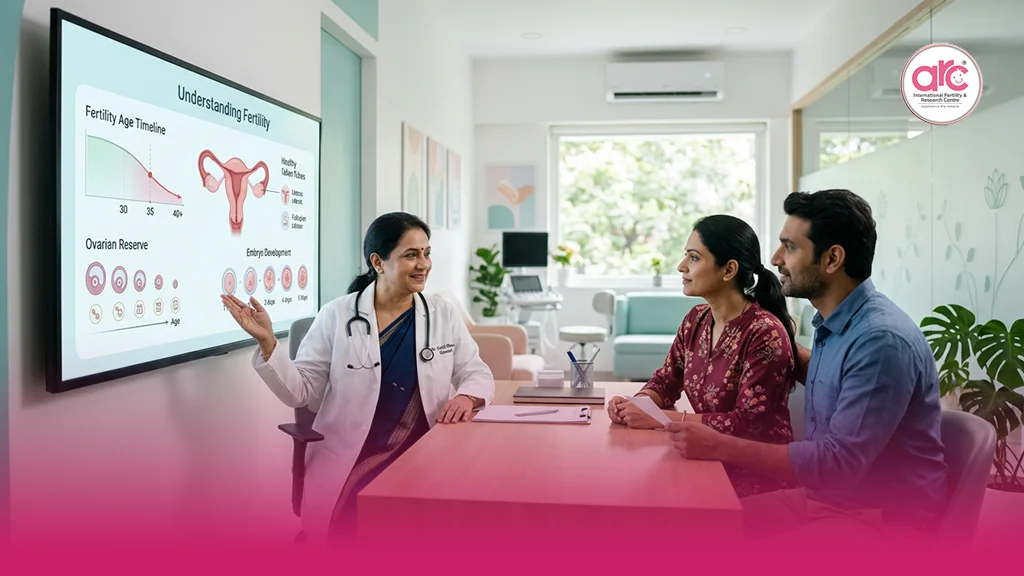
Advanced Maternal Age (AMA) is a term used when a woman becomes pregnant or plans to conceive at the age of 35 years or older. While many women today have healthy pregnancies in their late 30s and early 40s, age naturally affects fertility, egg quality, and pregnancy outcomes.
According to the American College of Obstetricians and Gynaecologists (ACOG), pregnancies at age 35 and older may require closer monitoring because certain maternal and foetal risks increase with age.
Hearing the term “advanced maternal age” can feel worrying, especially if you’re only beginning your journey towards parenthood. But it’s important to remember that AMA is not a diagnosis. It is simply a medical term that helps doctors identify pregnancies that may benefit from closer monitoring and personalised fertility care.
At ARC Fertility Hospitals, many women above 35 conceive naturally or with fertility treatments such as ovulation induction, IUI, or IVF. The key is understanding how age affects fertility so you can make informed decisions without unnecessary fear.
What Does Advanced Maternal Age Mean?
Women are born with all the eggs they will ever have. Unlike sperm, which are produced continuously throughout a man’s life, a woman’s egg supply naturally declines with age.
By the mid-30s, this decline becomes more noticeable. Both the number of eggs (ovarian reserve) and the quality of eggs gradually reduce, making conception more challenging compared to the early reproductive years.
This is why fertility specialists often recommend earlier evaluation for women over 35 who are trying to conceive.
Why Does Fertility Decline With Age?
The relationship between age and fertility is influenced by several biological changes.
Reduced Egg Quantity
Every menstrual cycle uses part of the remaining egg reserve. As women age, fewer follicles remain available in the ovaries.
Doctors often assess ovarian reserve using tests such as the following:
- Anti-Müllerian Hormone (AMH)
- Antral Follicle Count (AFC)
- Follicle Stimulating Hormone (FSH)
These tests estimate ovarian reserve but cannot predict pregnancy on their own.
Declining Egg Quality
Egg quality generally has a greater impact than egg quantity.
As women grow older, eggs are more likely to develop chromosomal abnormalities. This increases the chances of the following:
- Difficulty conceiving
- Failed implantation
- Miscarriage
- Chromosomal conditions such as Down syndrome
This explains why pregnancy rates gradually decline after the age of 35 and more significantly after 40.
Slower Response to Fertility Treatment
Women with reduced ovarian reserve may produce fewer eggs during IVF stimulation, requiring personalised treatment plans.
However, fewer eggs do not automatically mean poor outcomes. Individual response varies considerably.
Common Causes of Delayed Pregnancy
Today’s women often choose to start families later for many valid reasons.
Some of the most common include the following:
- Career goals
- Higher education
- Financial stability
- Finding the right partner
- Personal choice
- Previous medical conditions
- Fertility preservation decisions
Delaying pregnancy is increasingly common worldwide, making advanced maternal age an important topic in reproductive medicine.
Pregnancy Risks Associated With Advanced Maternal Age
Most women above 35 experience healthy pregnancies. However, certain risks become more common with increasing age.
These include:
Reduced Fertility
Natural conception rates gradually decline because ovulation becomes less predictable and egg quality decreases.
Increased Miscarriage Risk
Chromosomal abnormalities become more frequent with age, making miscarriage more likely.
Gestational Diabetes
Older mothers have a slightly higher chance of developing diabetes during pregnancy, which usually requires dietary management and closer monitoring.
High Blood Pressure
Pregnancy-induced hypertension and pre-eclampsia occur more often in women over 35.
Placental Problems
Certain placental conditions become slightly more common and may require specialised obstetric care.
Caesarean Delivery
Older mothers have a somewhat higher likelihood of requiring assisted delivery or Caesarean section.
Although these risks increase statistically, they do not mean complications are inevitable. Regular antenatal care helps detect problems early and improves outcomes.
Can You Still Conceive Naturally After 35?
Absolutely.
Many women conceive naturally in their late 30s and even early 40s.
Your chances depend on several factors, including:
- Ovulation
- Egg quality
- Ovarian reserve
- Partner’s sperm health
- Fallopian tube health
- Overall medical history
Age is one factor—not the only factor.
If pregnancy has not occurred after:
- 12 months of trying if under 35
- 6 months of trying if 35 or older
A fertility evaluation is recommended.
How Doctors Evaluate Fertility in Advanced Maternal Age
At ARC Fertility Hospitals, fertility assessment focuses on identifying the underlying reason for delayed conception rather than assuming age alone is responsible.
Evaluation may include:
- AMH blood test
- AFC ultrasound
- Hormonal profile
- Ovulation assessment
- Thyroid function
- Prolactin testing
- Semen analysis
- Tubal patency tests such as HSG
- Uterine evaluation
Understanding all fertility factors allows treatment to be tailored instead of making assumptions based solely on age.
Treatment Options
Treatment depends on the complete fertility evaluation.
Timed Intercourse
If ovulation is regular and fertility investigations are reassuring, doctors may recommend optimising natural conception.
Ovulation Induction
Women with irregular ovulation may benefit from medications that encourage healthy egg release.
Intrauterine Insemination (IUI)
IUI may be appropriate when:
- At least one fallopian tube is open
- Ovulation occurs
- Male-factor infertility is mild
In Vitro Fertilization (IVF)
IVF may be recommended when:
- Tubes are blocked
- Ovarian reserve is declining
- Male infertility is severe
- Previous treatments have failed
- Time is becoming an important consideration
IVF allows doctors to retrieve multiple eggs within one cycle and offers greater control over fertilisation and embryo development.
However, IVF is not automatically recommended simply because a woman is over 35. Treatment decisions should always be individualised.
Can Lifestyle Improve Fertility?
While age cannot be reversed, healthy habits can support reproductive health.
Doctors commonly recommend the following:
- Maintaining a healthy weight
- Regular moderate exercise
- Balanced nutrition
- Adequate sleep
- Smoking cessation
- Limiting alcohol
- Managing stress
- Controlling diabetes or thyroid disorders
These changes improve overall health and may support fertility treatment outcomes.
When Should You See a Fertility Specialist?
You should consider consulting a fertility specialist if:
- You are 35 or older and have been trying to conceive for six months.
- Your periods are irregular.
- You have PCOS or endometriosis.
- You have experienced recurrent miscarriages.
- You have had pelvic infections or surgery.
- Your partner has known sperm concerns.
Seeking advice earlier often provides more treatment options.
Many women searching for the best fertility hospital in Chennai are surprised to learn that early evaluation sometimes identifies simple, treatable causes before advanced treatment becomes necessary.
Similarly, choosing a trusted fertility hospital in Chennai means finding specialists who explain your fertility clearly, recommend investigations based on evidence, and personalise treatment according to your age, ovarian reserve, and reproductive goals.
Final Thoughts
Advanced maternal age simply means pregnancy at 35 years or older. While fertility naturally declines with age due to changes in egg quantity and quality, many women still achieve healthy pregnancies naturally or with fertility treatment.
The most important step is not worrying about the number itself; it is understanding what your own fertility looks like today. A timely fertility assessment can provide valuable information about ovarian reserve, ovulation, sperm health, and treatment options, helping you make confident decisions rather than relying on assumptions.
At ARC Fertility Hospitals, every fertility journey is approached individually because age is only one part of the story. With accurate evaluation, compassionate guidance, and personalised treatment, many women with advanced maternal age go on to build healthy families with confidence.