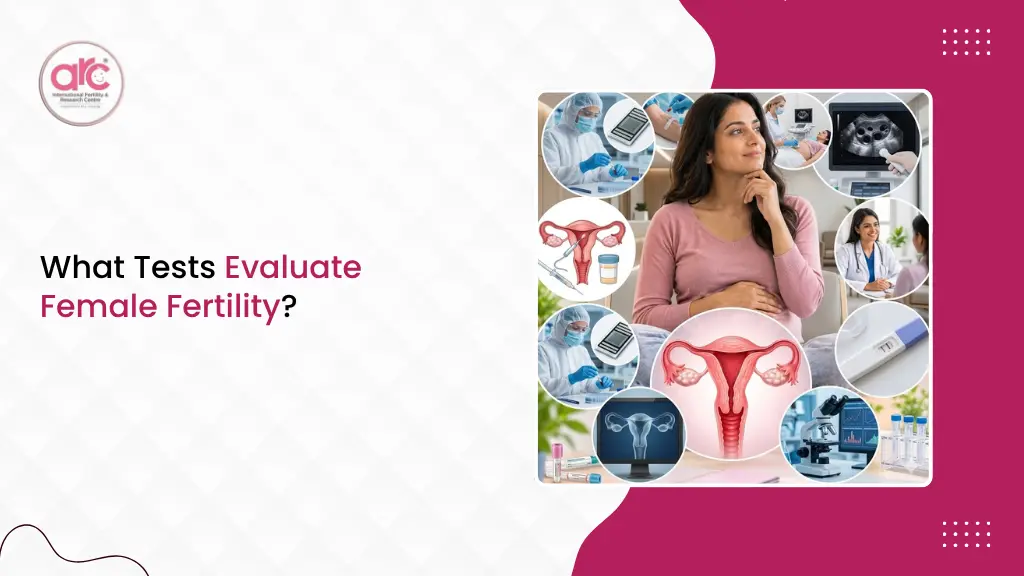
A full workup to evaluate female fertility involves blood tests for hormone levels, an ultrasound scan for egg count and uterine health, and sometimes a tubal check. Together, these results tell a doctor almost everything needed before treatment.
Couples trying to conceive often do not know where to begin. Blood work comes first, then imaging, and further procedures only if needed.
Why Do Doctors Evaluate Female Fertility Before Starting Treatment?
Treatment without a diagnosis is guesswork, which is why doctors evaluate female fertility before suggesting anything.
That single step saves months and helps evaluate female fertility issues, whether ovulation, egg count, or reproductive tract problems, before the plan is set.
Couples who evaluate female fertility early at the best ivf centre in Perambur tend to benefit in a few ways:
- The real cause gets identified instead of assumed
- Doctors can choose between medication, IUI, or IVF with confidence
- Expectations stay realistic from the first visit, whether the next step is medication or IVF treatment in Perambur
Which Blood Tests Are Used to Evaluate Female Fertility?
Blood work is where fertility testing begins, looking mainly at hormones that control ovulation and egg quality.
Typical panel:
- FSH (Follicle Stimulating Hormone), checked on day 2 or 3 of the cycle
- LH (Luteinising Hormone), which works with FSH to trigger ovulation
- AMH (Anti-Mullerian Hormone), a reliable marker of ovarian reserve
- TSH, since an underactive or overactive thyroid can throw off fertility
- Prolactin, because elevated levels can stop ovulation from happening on schedule
A doctor rarely reads one number alone; a proper attempt to evaluate female fertility needs the full set together.
How Does Ultrasound Help Evaluate Female Fertility?
Ultrasound gives a visual answer where blood tests only give numbers. Scanning the ovaries shows the antral follicle count, and scanning the uterus shows whether its shape and lining are normal.
The scan is timed for early in the cycle, when follicle counts read accurately.
A low count often signals reduced ovarian reserve, and the same scan catches fibroids, cysts, or a thin lining.
What Role Does Hysterosalpingography Play in Evaluating Female Fertility?
HSG checks what blood tests and ultrasound cannot: whether the fallopian tubes are open, checked whenever tubal blockage is suspected.
A dye passes into the uterus while X-ray images track its path; free-flowing dye is what doctors want.
Timing matters: the test happens after the period ends but before ovulation, keeping results accurate.
How Do Doctors Evaluate Female Fertility Through Ovarian Reserve Testing?
Egg quantity, not quality, is what ovarian reserve testing measures, and AMH remains the most trusted marker for it.
| Test | What It Measures | When It Is Done |
| AMH Blood Test | Ovarian reserve, egg quantity | Any day of the cycle |
| FSH Blood Test | Ovarian function | Day 2 or 3 of cycle |
| Antral Follicle Count | Number of visible follicles | Early cycle, via ultrasound |
Age still plays a role no test can override, since reserve naturally drops over the years.
Why Should You Choose an IVF Centre in Perambur to Evaluate Female Fertility?
Not every clinic reads these tests with the same accuracy, which is why picking the best IVF centre in Perambur matters. Experienced doctors and a well-equipped lab make the real difference.
A clinic doing IVF treatment in Perambur well usually has same-day hormone reports ready, an ultrasound machine on site rather than a referral elsewhere, and a doctor willing to sit and explain what the numbers actually mean.
A few questions are worth asking before committing to any IVF centre in Perambur:
- Does this ivf centre in Perambur or IVF treatment in Perambur provider run lab work in-house, or send samples out
- Has this specialist handled cases like yours before while working to evaluate female fertility, not just fertility cases in general
- Do they walk you through what comes next, or leave you to figure it out from a printout?
ARC Fertility Centre has earned its reputation as the best ivf centre in Perambur largely on this basis, pairing careful evaluation with dependable ivf treatment in Perambur from start to finish.
What Happens After Doctors Evaluate Female Fertility?
Once doctors evaluate female fertility and results are in, the conversation moves to ivf treatment in Perambur options at the chosen ivf centre in Perambur, whether medication, IUI, or IVF.
Most couples leave the best ivf centre in Perambur with a fairly clear timeline, and that clarity eases much of the planning stress.
Tests sometimes get repeated a few months in, to see whether the numbers used to evaluate female fertility have shifted.
Connect with ARC Fertility across social media like Facebook and Instagram and stay updated on fertility treatments, expert guidance, and success stories or you can directly connect on +91 9150915025.
Frequently Asked Questions
1. At what age should a woman evaluate female fertility?
Ideally after six months to a year of trying without success, or earlier if trying past age 35.
2. Is fasting required before fertility blood tests?
No, most fertility hormone tests do not require fasting beforehand.
3. How long does a full fertility evaluation take?
Most tests fit within one menstrual cycle, roughly three to four weeks.
4. Does a low AMH level mean IVF is the only option?
Not always. It depends on age, overall health, and the other results gathered to evaluate female fertility.
5. Is HSG a painful procedure?
It can cause mild cramping for a few minutes, similar to period pain.
Picking the best ivf centre in Perambur for this process tends to make the whole experience calmer and far less confusing.