Overview
She had been going to the gym six days a week.
Cardio every morning, an hour on the treadmill and sometimes more.
Three months in, but her PCOS symptoms had not improved. Her weight had barely shifted. And she was exhausted in a way that felt different from normal exercise fatigue.
Her body was not being lazy. It was responding, just not the way she expected.
What she needed was not more exercise. She needed the right exercise.
The 5 best exercise plan for PCOS to balance hormones and lose weight is not about pushing harder. It is about understanding how PCOS changes the way your body responds to physical activity and working with that biology rather than against it.
Here is what the research shows and what ARC recommends to every woman managing PCOS.
Why Exercise Affects PCOS Differently?
PCOS is a hormonal and metabolic condition, not simply a weight issue.
Elevated androgens, insulin resistance and disrupted cortisol patterns, all shape how a woman with PCOS responds to exercise. This is why the same gym routine that works for a friend without PCOS may feel ineffective or even counterproductive, when PCOS is in the picture.
“Regular exercise reduced testosterone levels by up to 15% and improved menstrual regularity in 57% of women with PCOS, without any medication change”, according to a 2024 meta-analysis published in The Journal of Clinical Endocrinology. Exercise is one of the most powerful interventions available for PCOS, when chosen correctly. It improves insulin sensitivity, reduces androgen levels, supports healthy body weight and can restore regular menstrual cycles.
The keyword is “choosing correctly”.
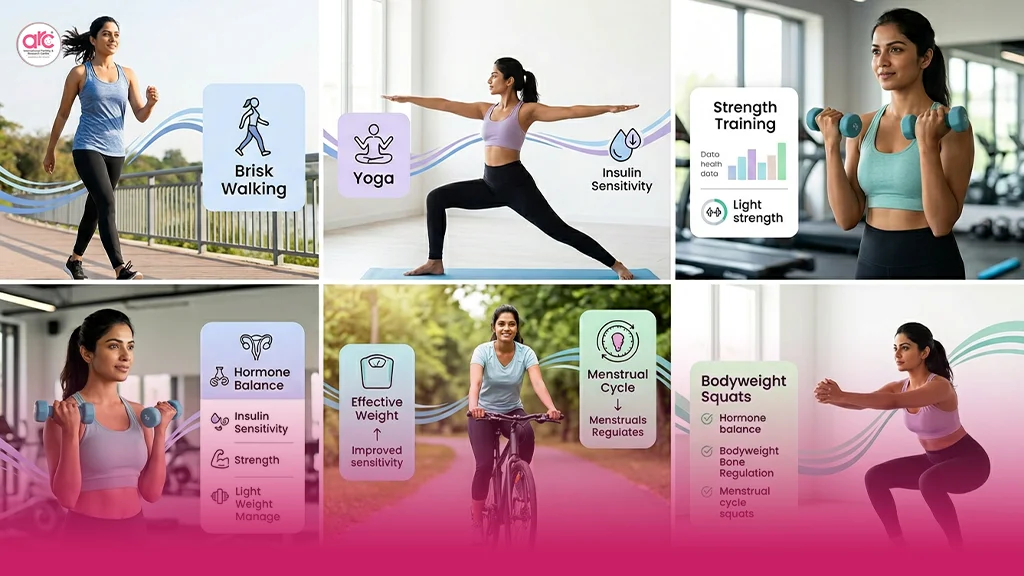
Exercise 1 – Strength Training: The Most Effective Choice for PCOS
If you have PCOS and can only do one type of exercise, make it strength training.
Building lean muscle mass dramatically improves insulin sensitivity and suppresses androgen activity. Even 2-3 sessions per week yields significant hormonal benefits within eight weeks: squats, deadlifts, lunges and compound movements that recruit multiple muscle groups simultaneously.
Slow weighted workouts can help reduce insulin resistance in women with PCOS. Lifting weights also helps build muscle, which keeps your metabolism moving even after your workout and can have a long-term impact on symptoms and weight.
Strength training also reduces cortisol, the stress hormone that, when chronically elevated, increases insulin and drives the androgen-insulin cycle that makes PCOS harder to manage.
You do not need intense heavy lifting. 30-40 minutes of slow, controlled resistance work 3-5 times a week is enough to shift the hormonal picture meaningfully.
Exercise 2 – Brisk Walking: Underrated, Consistent and Highly Effective
Of all the exercises recommended for PCOS, brisk walking is the one most consistently underestimated.
It improves insulin sensitivity without spiking cortisol, making it ideal for women who are already fatigued from PCOS symptoms or are new to structured exercise. 30-45 minutes at a pace where you can hold a conversation, done consistently, delivers measurable metabolic benefits over weeks.
Moderate aerobic exercise like brisk walking and cycling helps reduce insulin resistance and the associated risks of cardiovascular disease and type 2 diabetes. Keep cardio sessions under 60 minutes to minimise cortisol. Longer bouts can undermine hormonal balance.
Walking after meals is particularly valuable for women with PCOS, lowering post-meal glucose spikes and reducing the insulin surges that drive androgen production.
Exercise 3 – HIIT (Done Correctly): Powerful in Short Doses
High-intensity interval training (HIIT) is effective for PCOS when applied with restraint.
A 2018 meta-analysis found that, “15-minute HIIT sessions thrice a week trimmed BMI by 1.5 kg/m² in women with PCOS, outperforming 40-minute steady-state cardio”. Across 19 trials, vigorous-intensity workouts cut insulin resistance by 36% and shrank waistlines by 4.2%.
But the restraint part matters.
Do not do high-intensity exercise without adequate rest. High-intensity workouts can stimulate stress hormones. Consider balancing intense workouts with low or moderate exercise and sufficient recovery. Keep HIIT sessions short, 15-20 minutes and limit them to 2 sessions per week maximum, paired with gentler movement on other days.
HIIT is a tool for PCOS, not a daily habit.
Exercise 4 – Yoga: The Cortisol Regulator PCOS Needs
There is evidence to suggest that mind-body exercises like yoga can improve anxiety, hormones, menstrual cycles and metabolic parameters in women with PCOS, more so than some intense exercises.
Gentle yoga twice a week reduced salivary cortisol by 22%, a meaningful reduction in the stress hormone that directly feeds back into insulin resistance and androgen production.
For women with PCOS who are already dealing with fatigue, mood changes and disrupted cycles, yoga offers something that no high-intensity session can. A systematic reduction in the cortisol load that makes all other PCOS symptoms harder to manage.
Yoga for PCOS does not need to be advanced. A beginner sequence focused on hip openers, spinal twists and restorative poses done thrice a week alongside other exercise types is enough to shift the cortisol picture measurably.
Exercise 5 – Cycling: Low Impact, Hormonally Friendly Cardio
Cycling, whether outdoors or on a stationary bike, provides meaningful cardiovascular benefit without the joint stress of running or the cortisol spike of prolonged high-intensity cardio.
It builds lower body muscle, improves cardiovascular fitness and supports insulin sensitivity, all relevant to PCOS management. Combined with resistance training in a weekly plan, cycling fills the moderate cardio requirement that the research consistently supports. 150 minutes per week of moderate aerobic activity.
For women in Chennai where outdoor walking may be limited by heat during summer months, a stationary bike offers a climate-controlled alternative that keeps the weekly movement target achievable year-round.
The 5 Best Exercise Plan for PCOS to Balance Hormones and Lose Weight: Weekly Framework
Here is how ARC suggests combining all five into a realistic weekly structure:
|
Day |
Exercise |
Duration |
|---|---|---|
|
Monday |
Strength training |
40 minutes |
|
Tuesday |
Brisk walking |
30 minutes |
|
Wednesday |
Yoga |
30 minutes |
|
Thursday |
HIIT |
15-20 minutes |
|
Friday |
Strength training |
40 minutes |
|
Saturday |
Cycling or brisk walking |
30-45 minutes |
|
Sunday |
Rest or gentle stretching |
– |
Most women with PCOS lose weight fastest with a blended routine of 150 minutes per week of moderate cardio, two 30-minute strength sessions and 2 brief HIIT workouts. Studies show this combination can reduce body weight by 6-10% in 12 weeks and lower insulin by up to 30%.
What to Avoid? Exercises That Make PCOS Worse
Not everything that feels like effort is moving you forward with PCOS.
Prolonged high-intensity cardio sessions, running for an hour daily, intense spin classes six days a week, consistently elevate cortisol in women with PCOS. Elevated cortisol increases insulin. Elevated insulin drives androgen production. The cycle that causes PCOS symptoms gets amplified rather than reduced.
This is what happened to the woman at the start of this blog. More cardio was not the answer. A smarter combination was!
Exercise Is One Part; Not the Complete Picture
Exercise works best for PCOS when it sits alongside the right medical evaluation and treatment.
If your cycles remain irregular despite consistent exercise, if weight is not responding despite effort or if symptoms like facial hair, acne or fatigue are persisting, it is time to go deeper than lifestyle management alone.
Understanding what treatment options exist for PCOS, including medication, ovulation induction and hormonal support is covered in depth in our complete PCOS treatment guide for Chennai patients. And if ovulation induction is part of your treatment plan, our guide on letrozole vs Clomid for PCOS explains the medication comparison clearly.
According to the American College of Sports Medicine, adults should aim for at least 150 minutes of moderate-intensity aerobic activity per week combined with muscle-strengthening activities on two or more days, guidelines that align directly with what the PCOS research supports.
At a dedicated fertility hospital in Chennai, the approach to PCOS management at ARC integrates lifestyle guidance, including personalised exercise recommendations with hormonal evaluation, metabolic assessment and fertility treatment where needed.
Because exercise without medical context is guesswork. And medical treatment without lifestyle support leaves results on the table.
At the best fertility hospital in Chennai, both work together at ARC, so every woman with PCOS has the complete picture, not just part of it.
Your body is not working against you.
It is working with the hormonal environment it has been given.
Change the environment with the right exercise, the right frequency, the right medical support and the body responds.
That is not wishful thinking. That is exactly what the research shows.
Frequently Asked Questions (FAQs)
Q1. How often should I exercise if I have PCOS?
Aim for at least 150 minutes of moderate exercise per week, combining strength training, brisk walking and yoga across 5-6 days. Consistency matters more than intensity for PCOS.
Q2. Can exercise alone cure PCOS?
No, but it is one of the most powerful management tools available. Regular exercise can improve insulin sensitivity, reduce androgen levels and restore menstrual regularity, but it works best alongside proper medical evaluation and treatment.
Q3. Is running bad for PCOS?
Not inherently! But prolonged daily running can spike cortisol, which worsens insulin resistance and androgen levels. Short, moderate runs or brisk walking are safer and more hormonally friendly choices for most women with PCOS.
Q4. How long does exercise take to reduce PCOS symptoms?
Most women see measurable improvements in insulin sensitivity and menstrual regularity within 8-12 weeks of consistent exercise. Hormonal changes, including reduced testosterone, have been documented within eight weeks of starting strength training.
Q5. Should I exercise during my period with PCOS?
Yes, light to moderate exercise during your period is generally beneficial and can reduce cramping and fatigue. Avoid high-intensity sessions on the heaviest flow days and listen to your body’s energy signals throughout the cycle.