Overview
She had tried everything she could find online.
Spearmint tea, seed cycling, cutting out sugar, a strict 10 PM bedtime.
Her periods still arrived or did not, on their own unpredictable schedule.
Then a friend mentioned progesterone suppositories. Said she had been prescribed them. Said her cycles had improved.
Could something that straightforward actually help?
Can taking progesterone suppositories fix irregular periods?
It is a question that sits at the intersection of genuine hormonal science and widespread misunderstanding. The answer is more nuanced than the internet typically suggests and at ARC, we believe every woman deserves the complete picture, not just the parts that are easy to explain in a short post.
What Progesterone Actually Does in the Menstrual Cycle?
Before the suppository question makes sense, the hormone itself needs to be understood.
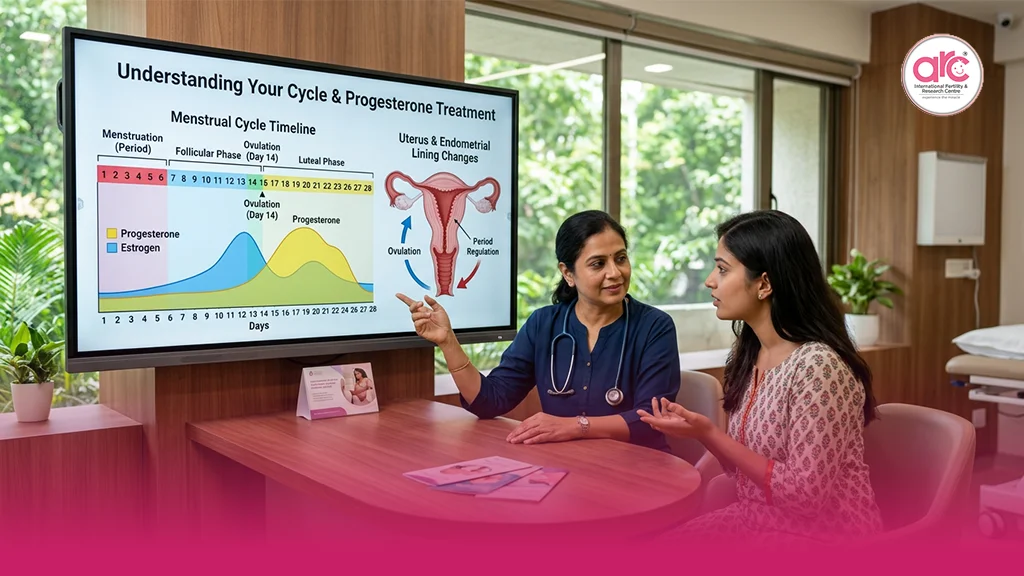
Progesterone is produced after ovulation by the corpus luteum, the temporary structure that forms when a follicle releases an egg. Its job in the second half of the cycle (the luteal phase), is to prepare and maintain the uterine lining for a potential pregnancy.
If pregnancy does not occur, progesterone drops. That drop triggers the lining to shed. That shedding is your period.
The luteal phase runs from 11 to 17 days after ovulation. If the luteal phase is shorter than 10 days, it may be considered luteal phase deficiency, a condition where insufficient progesterone production shortens the second half of the cycle.
This is the specific scenario where progesterone supplementation, including suppositories, has the most direct clinical relevance.
Can Taking Progesterone Suppositories Fix Irregular Periods? The Honest Clinical Answer
Here is where precision matters.
Progesterone suppositories help women experiencing short luteal phases, luteal phase defects affecting fertility, irregular menstrual cycles and premenstrual syndrome symptoms. Research has found that suppositories help women reach progesterone levels similar to those of women with normal luteal phases.
So yes, for irregular periods caused specifically by low progesterone or luteal phase deficiency, progesterone suppositories can be genuinely effective.
But this is where the critical nuance arrives.
Irregular periods are not all caused by the same thing.
PCOS causes irregular periods, but through elevated androgens and insulin resistance disrupting ovulation, not through a primary progesterone deficiency. Thyroid dysfunction causes irregular periods, but through disrupted TSH signalling, not through a progesterone production problem. Stress-related anovulation causes irregular periods, because without ovulation, the corpus luteum never forms and therefore progesterone is never produced in the first place.
In these cases, taking progesterone suppositories may trigger a withdrawal bleed, which can look like a period, but it does not address the underlying reason why ovulation is not happening. The cycle that follows may be just as irregular as before.
Your healthcare provider may recommend progesterone supplementation if blood or urine tests show your progesterone levels are consistently low and/or if you’re experiencing symptoms like irregular cycles, difficulty conceiving or recurrent miscarriages.
The key phrase is blood tests showing low progesterone. Self-prescribing progesterone suppositories without a confirmed diagnosis is where the treatment often goes wrong, masking symptoms without treating their cause.
What Progesterone Suppositories Actually Fix and What They Do Not?
This distinction is worth being clear about.
i) Progesterone suppositories can help with:
Luteal phase deficiency, where progesterone levels drop too quickly after ovulation, causing a short second half of the cycle and early menstruation. Diagnosed low progesterone confirmed on blood testing done seven days after ovulation. Irregular periods in women who are ovulating but producing insufficient post-ovulatory progesterone. Support in early pregnancy where progesterone levels are confirmed low and miscarriage risk is elevated.
ii) Progesterone suppositories cannot fix:
Irregular periods caused by anovulation, if you are not ovulating, progesterone supplementation provides a temporary hormonal environment but does not restore the ovulatory mechanism. PCOS-related cycle disruption where insulin resistance and androgen excess are the root drivers. Thyroid-related menstrual irregularity where TSH is out of range. Stress-induced hypothalamic amenorrhoea where the brain has suppressed the entire hormonal cascade.
Progesterone production in the corpus luteum depends entirely on ovulation. There is a lack of randomized recommendations for short-term use of oral progestogens, which may reduce the volume and duration of bleeding and may positively influence endometrial histology.
This means: If ovulation is not occurring, external progesterone is working around the problem, not through it.
The Luteal Phase Connection: When Suppositories Make Sense?
If your period arrives consistently earlier than expected, at day 22 or 23 of a cycle that used to run to day 28 and you are ovulating but your second phase is shortened, this is the scenario where progesterone supplementation has the most direct benefit.
A luteal phase of fewer than 10 days is consistently associated with difficulty conceiving, because even when fertilisation occurs, a rapidly dropping progesterone level means the uterine lining begins to shed before an embryo has had time to implant.
Research has found that suppositories help women reach progesterone levels similar to those of women with normal luteal phases. In assisted reproductive technology, progesterone suppositories play a vital role in treatment success, thickening the uterine lining to create optimal conditions for implantation and supporting embryo attachment by maintaining proper endometrial receptivity.
For women in this specific category, confirmed short luteal phase, confirmed low mid-luteal progesterone, suppositories can meaningfully extend the second half of the cycle and improve the uterine environment for both natural conception and assisted reproduction.
Progesterone Suppositories: What the Experience Is Like?
This is the practical information most women want before starting.
Progesterone suppositories are inserted vaginally, typically once or twice daily in the second half of the cycle, from ovulation confirmation until either menstruation begins or pregnancy is confirmed. They dissolve gradually, releasing progesterone locally before it is absorbed systemically.
Risks involve side effects like vaginal irritation, dizziness and nausea. They are typically prescribed during IVF or for luteal phase defects under medical supervision.
Discharge, white or yellowish, is normal and expected as the suppository dissolves. This is not a sign of infection. Wearing a liner on days of use is practical and commonly recommended.
Dizziness is more likely if suppositories are taken at the wrong time of day, taking them at night before bed minimises this side effect for most women.
If you are currently in fertility treatment and using progesterone suppositories post-transfer, our guide on progesterone oil vs capsules and which prevents miscarriage better compares the different delivery forms and what the research shows about effectiveness in early pregnancy support.
And if you are tracking your cycle and wondering what elevated progesterone levels feel like in the days after ovulation, our guide on signs of high progesterone after ovulation covers the physical signals your body sends when progesterone is doing its job, a useful companion if you are actively monitoring your cycle.
What ARC Recommends Before Starting Progesterone Supplementation?
At ARC, progesterone suppositories are never the first recommendation before a diagnosis is confirmed.
The evaluation begins with:
- Day 21 progesterone blood test: Taken seven days after confirmed ovulation to measure mid-luteal progesterone levels. This is the gold standard for diagnosing luteal phase deficiency.
- Ovulation confirmation: Through basal body temperature tracking, LH surge testing or transvaginal ultrasound. Without confirmed ovulation, progesterone testing is meaningless.
- Full hormonal panel: FSH, LH, AMH, estradiol, thyroid function and, where PCOS is suspected, androgens and fasting insulin. These identify whether the irregular cycle is rooted in low progesterone or in something else entirely.
According to the American College of Obstetricians and Gynecologists, irregular uterine bleeding warrants proper evaluation to identify the underlying cause before any hormonal treatment is initiated. Treating irregular periods with progesterone without first identifying why the cycle is irregular is treating a symptom, not a condition.
At a dedicated fertility hospital in Chennai, the approach to irregular periods at ARC begins with exactly this kind of complete hormonal picture, not a suppository prescription written at the end of a rushed appointment, but a proper investigation that matches the treatment to the actual cause.
At the best fertility hospital in Chennai, ARC treats irregular periods as the hormonal signal they are, something to investigate properly, not to paper over with a prescription that may not address what is actually happening.
Final Thoughts
She found out her luteal phase was 8 days.
Her progesterone on day 21 was barely half of where it needed to be.
That diagnosis changed everything, because now the treatment was matched to the actual problem.
The suppositories helped.
Not because she took them hoping they would.
Because her body actually needed them.
Frequently Asked Questions (FAQs)
Q1. Can progesterone suppositories regulate irregular periods?
Yes, but only when low progesterone or luteal phase deficiency is the confirmed cause. For irregular periods caused by PCOS, thyroid dysfunction or anovulation, suppositories address symptoms but not the root hormonal problem.
Q2. Do progesterone suppositories induce a period?
Yes, stopping progesterone after a course will trigger a withdrawal bleed that resembles a period. However, this is not the same as a natural menstrual cycle driven by ovulation and is not a long-term solution for irregular cycles.
Q3. How do I know if my irregular periods are caused by low progesterone?
A blood test measuring progesterone on day 21 of your cycle or 7 days after confirmed ovulation, is the most reliable way to confirm low progesterone as the cause. Self-diagnosing without testing is not recommended.
Q4. Are progesterone suppositories safe to use without a prescription?
Progesterone suppositories are a prescription medication and should only be used under medical supervision. Using them without a confirmed diagnosis can mask underlying hormonal conditions that require different treatment.
Q5. How long does it take for progesterone suppositories to regulate the cycle?
When correctly prescribed for luteal phase deficiency, most women see improvement within two to three cycles. Cycle regularity depends on addressing the underlying hormonal cause, not simply on how long the suppositories are used.