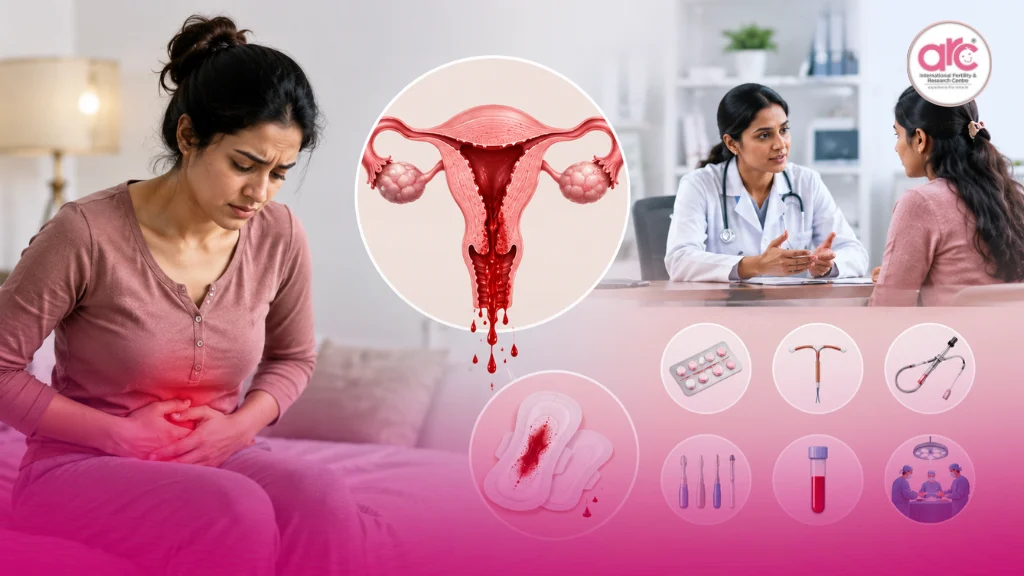
Heavy Menstrual Bleeding is not something to wait out. Doctors mark it as blood loss above 80 ml per cycle, or periods running past seven days. Once it eats into work, sleep, or basic energy, it needs a proper check-up. Most women dealing with it change pads every hour, push through large clots, and feel wiped out by the third or fourth day. Ignore it long enough, and it can slide into anaemia.
What Is Heavy Menstrual Bleeding?
Doctors call it menorrhagia. In plain terms, it means periods that run heavier or longer than what counts as normal.
A woman going through this usually notices:
- Pads need changing every one to two hours, sometimes less
- Clots the size of a coin, or bigger, show up during flow
- Night protection has to be doubled just to get through till morning
- Tiredness or breathlessness sets in partway through the cycle
None of these should be brushed off as “just a heavy month.” If they repeat, a gynaecologist visit is overdue.
What Causes Heavy Menstrual Bleeding?
Hormones are usually the first suspect. When oestrogen and progesterone fall out of balance, the uterine lining builds up more than it should, and that shows up as heavier flow.
Fibroids and polyps come next, followed by thyroid issues and clotting disorders. Age plays a part too – teenagers whose cycles haven’t settled yet, and women nearing menopause, tend to see more of this.
There is also a Chennai-specific angle. Long work hours, skipped meals, and barely any physical movement build up over months, and gynaecologists across the city see this pattern often in working women.
When Should You See a Doctor for Heavy Menstrual Bleeding?
Once periods stretch past a week, or symptoms of anaemia show up, it’s time to book an appointment. A sudden change in bleeding pattern is also worth flagging early.
A few red flags to watch for:
- Periods running longer than seven days
- Bleeding that shows up outside the normal cycle
- Sharp pain combined with heavy flow
- Dizziness that doesn’t go away with rest
Waiting rarely makes it better. Whatever is causing the bleeding tends to get worse the longer it’s left alone.
How Is Heavy Menstrual Bleeding Diagnosed?
It starts with a physical exam, then blood work, then West Tambaram fertility centre, then a pelvic ultrasound. Between the three, doctors get a clear read on what’s going on.
| Diagnostic Step | Purpose |
| Physical examination | Checks general health and pelvic area |
| Blood test | Detects anaemia and hormone levels |
| Ultrasound scan | Identifies fibroids, polyps, or cysts |
| Endometrial biopsy | Examines uterine lining tissue |
Once results come back, the gynaecologist has enough to suggest a treatment path that fits the actual cause.
What Are the Treatment Options for Heavy Menstrual Bleeding in Chennai?
Options in Chennai stretch from basic medication to short surgical procedures, and the right one depends on how severe things are and what’s driving them.
| Treatment Type | Suitable For | Recovery Time |
| Hormonal medication | Mild to moderate cases | No downtime |
| Tranexamic acid tablets | Short-term relief during periods | No downtime |
| Hysteroscopy | Removal of polyps or fibroids | One to two days |
| Endometrial ablation | Women not planning pregnancy | Few days |
| Hysterectomy | Severe, recurring cases | Few weeks |
Clinics differ in how they read the underlying cause. A gynaecologist with genuine experience in IVF treatment in Egmore here tends to get the treatment right the first time.
Can Heavy Menstrual Bleeding Affect Fertility?
Sometimes, yes. Fibroids, polyps, and hormonal swings don’t just cause heavier periods – they can make conception harder too.
Women trying to get pregnant shouldn’t sit on this too long. Early evaluation tends to lead to better outcomes. It’s fairly common for women dealing with both Heavy Menstrual Bleeding and fertility struggles to see a fertility specialist alongside their regular gynaecologist.
Where Can You Find the Best IVF Centre in Egmore for Heavy Menstrual Bleeding Treatment?
Look for a clinic that handles gynaecological care and fertility centre in Pammal and fertility treatment together, rather than sending patients back and forth. That’s the model the best IVF centre in Egmore usually follows, and it’s worth checking a clinic’s record before choosing the best IVF centre in Egmore for this kind of combined care.
The best IVF centre in Egmore tends to bring sharper diagnostic tools and doctors who already understand how Heavy Menstrual Bleeding connects to fertility issues.
Women in Chennai juggling Heavy Menstrual Bleeding and fertility concerns at the same time can look at ARC Fertility, recognised as the best IVF centre in Egmore, where both are handled under one plan.
Learn when heavy menstrual bleeding needs medical attention and treatment options in Chennai—follow us on Instagram & YouTube for expert guidance.
Frequently Asked Questions
Is Heavy Menstrual Bleeding a serious condition?
It can be, especially if it leads to anaemia or points to something like fibroids underneath.
How much bleeding counts as Heavy Menstrual Bleeding?
Anything above 80 ml per cycle, or periods stretching past seven days, fits the definition.
Can Heavy Menstrual Bleeding be treated without surgery?
Often, yes. Hormonal medication and tranexamic acid tablets handle many cases on their own.
Does stress cause Heavy Menstrual Bleeding?
It can. Stress throws hormones off balance, and that sometimes shows up as heavier periods.
Should I visit a fertility clinic for Heavy Menstrual Bleeding?
Worth it, yes – especially if it’s making conception harder. A fertility clinic can treat both together.